

 العربية
 Deutsch
 Română
 Čeština
 Magyar
 Svenska
 Polski
 Hrvatski
 עברית
עברית Ελληνικά
 Português
 Português (Brasil)
 Slovenščina
 Српски
 Македонски
 Български
 Français
 Español
 Español (Colombia)
 Español (Argentina)
 Español (México)
 Català
 Türkçe
 Nederlands
 Italiano
 Bahasa Indonesia
 日本語
日本語 简体中文
简体中文 繁體中文
繁體中文 हिन्दी
 العربية (مصر)
 Shqip
Shqip ไทย
ไทย Русский
 فارسی
فارسی Українська
 Filipino
 اردو
اردو
大日本帝国海軍

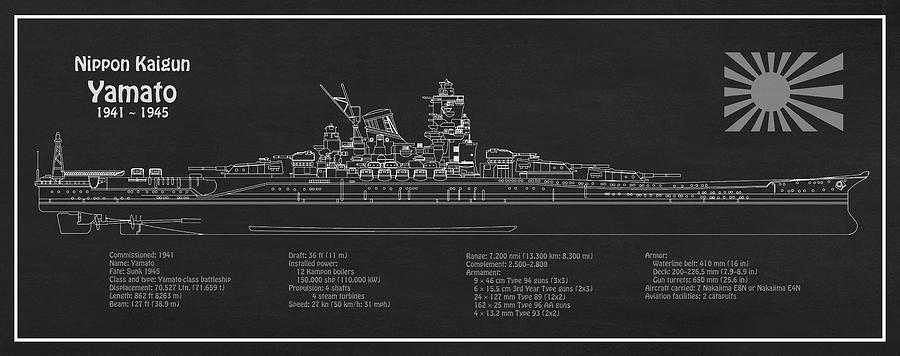
Yamato (大和) was the lead ship of her class of battleships built for the Imperial Japanese Navy (IJN) shortly before World War II.
She and her sister ship, Musashi, were the heaviest and most powerfully armed battleships ever constructed, displacing 72,800 tonnes at full load and armed with nine 46 cm (18.1 in) Type 94 main guns, which were the largest guns ever mounted on a warship.
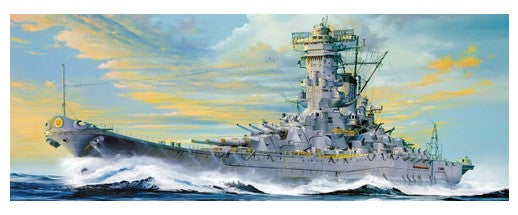
Named after the ancient Japanese Yamato Province, Yamato was designed to counter the numerically superior battleship fleet of the United States, Japan's main rival in the Pacific.
She was laid down in 1937 and formally commissioned a week after the Pearl Harbor attack in late 1941. Throughout 1942, she served as the flagship of the Combined Fleet, and in June 1942 Admiral Isoroku Yamamoto directed the fleet from her bridge during the Battle of Midway
Musashi took over as the Combined Fleet flagship in early 1943, and Yamato spent the rest of the year, and much of 1944, moving between the major Japanese naval bases of Truk and Kure in response to American threats. Although present at the Battle of the Philippine Sea in June 1944, she played no part in the battle.
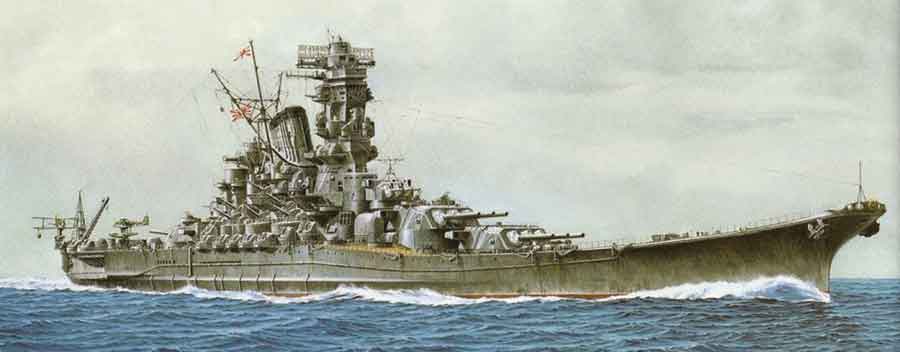
The only time Yamato fired her main guns at enemy surface targets was in October 1944, when she was sent to engage American forces invading the Philippines during the Battle of Leyte Gulf.
On the verge of success, the Japanese force turned back, believing they were engaging an entire US carrier fleet rather than a light escort carrier group that was all which stood between the battleship and vulnerable troop transports.
During 1944, Yamato was dispatched on a one-way mission to Okinawa in April 1945, with orders to beach herself and fight until destroyed protecting the island.
The task force was spotted south of Kyushu by US submarines and aircraft, and on 7 April 1945 she was sunk by American carrier-based bombers and torpedo bombers with the loss of most of her crew.
Design and construction
During the 1930s the Japanese government adopted an ultranationalist militancy with a view to greatly expand the Japanese Empire. Japan withdrew from the League of Nations in 1934, renouncing its treaty obligations.
After withdrawing from the Washington Naval Treaty, which limited the size and power of capital ships, the Imperial Japanese Navy began their design of the new Yamato class of heavy battleships.

Their planners recognized Japan would be unable to compete with the output of U.S. naval shipyards should war break out, so the 70,000 ton vessels of the Yamato class were designed to be capable of engaging multiple enemy battleships at the same time.
The keel of Yamato, the lead ship of the class, was laid down at the Kure Naval Arsenal, Hiroshima, on 4 November 1937, in a dockyard that had to be adapted to accommodate her enormous hull.
The dock was deepened by one meter, and gantry cranes capable of lifting up to 350 tonnes were installed. Extreme secrecy was maintained throughout construction, a canopy even being erected over part of the drydock to screen the ship from view. Yamato was launched on 8 August 1940,
with Captain (later Vice-Admiral) Miyazato Shutoku in command. A great effort was made in Japan to ensure that the ships were built in extreme secrecy to prevent American intelligence officials from learning of their existence and specifications
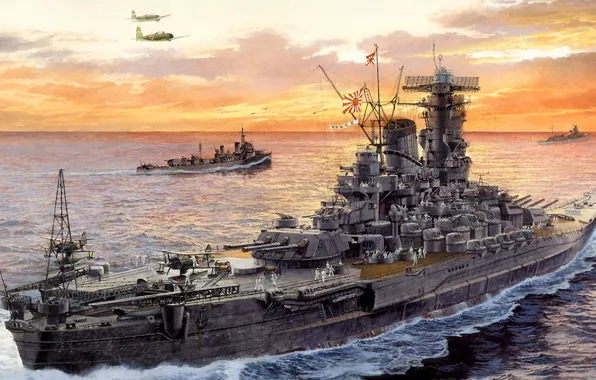
Yamato's main battery consisted of nine 46 cm (18.1 in) 45 Caliber Type 94 naval guns—the largest caliber of naval artillery ever fitted to a warship, although the shells were not as heavy as those fired by the British 18-inch naval guns of World War I.
Each gun was 21.13 metres (69.3 ft) long, weighed 147.3 metric tons (162.4 short tons), and was capable of firing high-explosive or armor-piercing shells 42 kilometres (26 mi). Her secondary battery comprised twelve 155-millimetre (6.1 in) guns mounted in four triple turrets (one forward, one aft, two midships), and twelve 127-millimetre (5.0 in) guns in six twin mounts (three on each side amidships).
These turrets had been taken off the Mogami-class cruisers when those vessels were converted to a main armament of 20.3-centimetre (8.0 in) guns. In addition, Yamato carried twenty-four 25-millimetre (0.98 in) anti-aircraft guns, primarily mounted amidships. When refitted in 1944 and 1945 for naval engagements in the South Pacific, the secondary battery configuration was changed to six 155 mm guns and twenty-four 127 mm guns, and the number of 25 mm anti-aircraft guns was increased to 162.
