

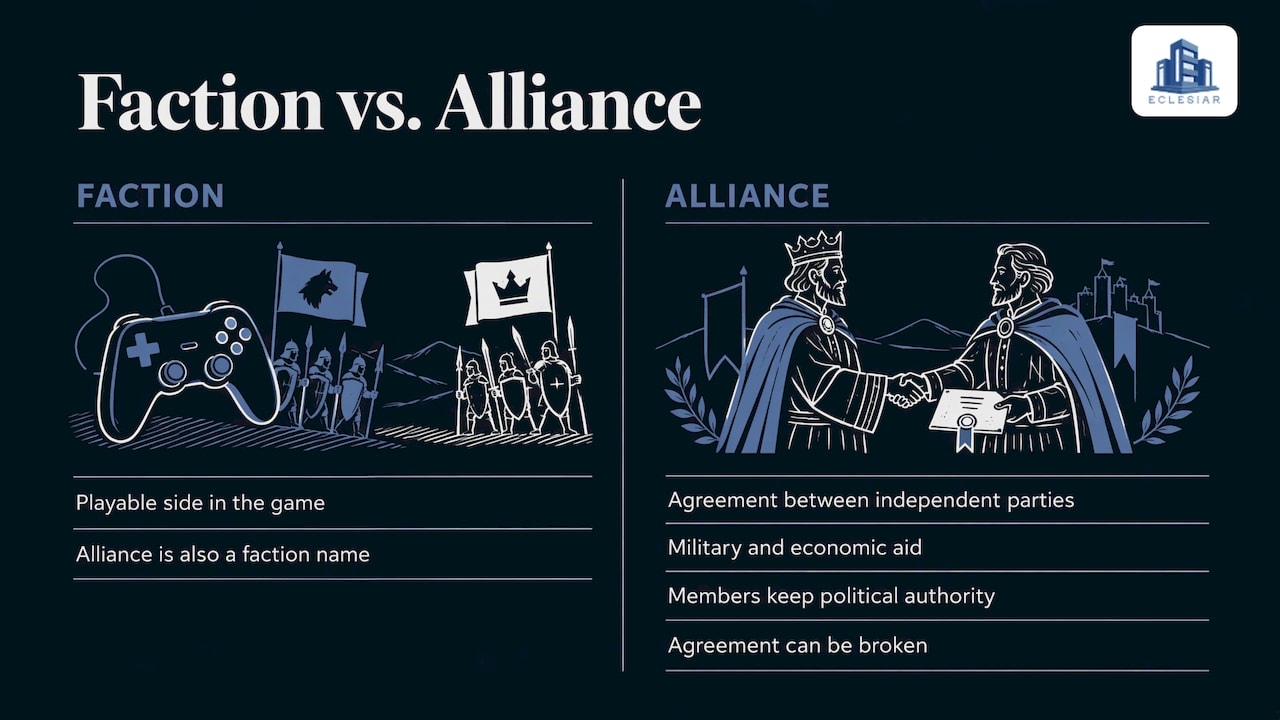
A faction is a group you belong to, and an alliance is an agreement between groups. That is the short answer, and it explains why the two words get tangled. In World of Warcraft, “Alliance” is the name of one of the two factions, so players ask whether they are choosing a faction or an alliance when they are choosing both at once. In strategy games more broadly, the two ideas separate cleanly: a faction is the side you are on, and an alliance is a pact you make with other players or nations. In a persistent world like Eclesiar, where players lead nations, fight wars and shape politics together, that difference decides how you play.
TL;DR
- Faction means a side or group with shared goals, identity or rules. Alliance means a cooperative agreement between groups, or, in World of Warcraft, the name of one faction.
- In World of Warcraft, the Alliance and the Horde are the two playable factions. Your race decides which one you join, and that choice affects quests, cities and who you can group with in the open world.
- In strategy and simulation games, factions are usually fixed or hard to change, while alliances are chosen, negotiated and can be broken.
- Alliances matter most in games where decisions are made by players, because shared wars, trade and politics are built through agreements between real people.
- If you want a free browser or mobile strategy game where alliances and rivalries shape the world, Eclesiar is built around exactly that.
Table of Contents
- What a faction is
- What an alliance is
- Why the terms overlap in World of Warcraft
- Faction vs alliance side by side
- Which one matters more in a strategy game
- How to choose and use alliances well
- Where this plays out in Eclesiar
- Eclesiar: a place to build alliances
- Our perspective
- FAQ
- Sources
What a faction is
A faction is an organized group with shared goals, an ideology or an identity. In games, the word usually describes a side that comes with built-in rules: who your characters can talk to, which areas they can enter, and who counts as an enemy. Warcraft’s own community reference describes factions as groups defined by shared goals, ideology or racial identity, used mainly to dictate how characters interact with non-player characters (NPCs, the computer-controlled characters) and with other players.
Three things tend to be true of a faction in most games:
- You are assigned or you choose once. Often the choice happens at character creation and is tied to something like race, nation or class.
- It sets the default relationship with everyone else. Some factions are friendly by default, others hostile.
- It is stable. Changing sides usually requires a special mechanic, a cost or a restart.
That last point is the big contrast with an alliance.
What an alliance is
An alliance is a relationship, not an identity. Two or more parties agree to cooperate: share military support, trade on better terms, coordinate attacks or defend each other. Because it is an agreement, it can be negotiated, renewed, tested and broken.
The Warcraft setting itself shows this nicely. The Alliance in Warcraft lore is not one uniform government. It is described as a coalition of mutual military and economic aid among member states, where each member’s leaders keep supreme authority over their own politics, internal laws, economy and military. That is an alliance in the strict sense: independent parties bound by an agreement. Yet the game also uses the same word as the name of a player faction, which is where the confusion starts.
Why the terms overlap in World of Warcraft
The search results for this keyword are almost entirely about World of Warcraft, so it is worth being precise about that game.
In World of Warcraft, “faction” has two meanings. It can mean any organized group, including in-game reputation factions you earn standing with. It also refers to the two primary playable sides: the Alliance and the Horde. So “faction vs alliance” in that game is really a category question, like asking “fruit vs apple.” The Alliance is one faction, and the Horde is the other.
How the Alliance and Horde differ
The contrast is mostly about identity and tone:
- Alliance: In its lore, the Alliance seeks order and emphasizes honor and tradition. Its races are humans, dwarves, night elves and gnomes, and the Warcraft Wiki entry describes it as bound by nobility, honor, faith, justice and sacrifice.
- Horde: The Horde is a coalition of different races and cultures joined as an alliance of convenience against a hostile world, made up of outsiders who value strength and honor. Its original races are orcs, Darkspear trolls, tauren and the undead Forsaken.
So even the lore plays with our keyword: the Horde is described as an alliance of convenience, while the Alliance is a faction built on shared values.
Quests, cities and starting areas
Faction membership affects which settlements, NPCs, quests and reputations a player can reach. Starting areas are a good example. According to the starting areas guide, Horde orcs begin in the Valley of Trials in Durotar and tauren in Camp Narache in Mulgore, while Alliance humans begin in Northshire Valley in Elwynn Forest and dwarves in Coldridge Valley in Dun Morogh.
There is also a communication barrier. In early versions of the game, opposing-faction players could not group or guild together and their speech was rendered unintelligible. Most player-versus-player (PvP) fighting still pits Alliance against Horde.
Class locks used to be part of the difference
In the original game, paladins were Alliance-only and shamans Horde-only. According to the same history of Warcraft’s races and factions, The Burning Crusade expansion later gave the Alliance draenei shamans and the Horde blood elf paladins. If you read older forum threads, much of the “which faction is better” argument comes from that era.
Does the choice still matter?
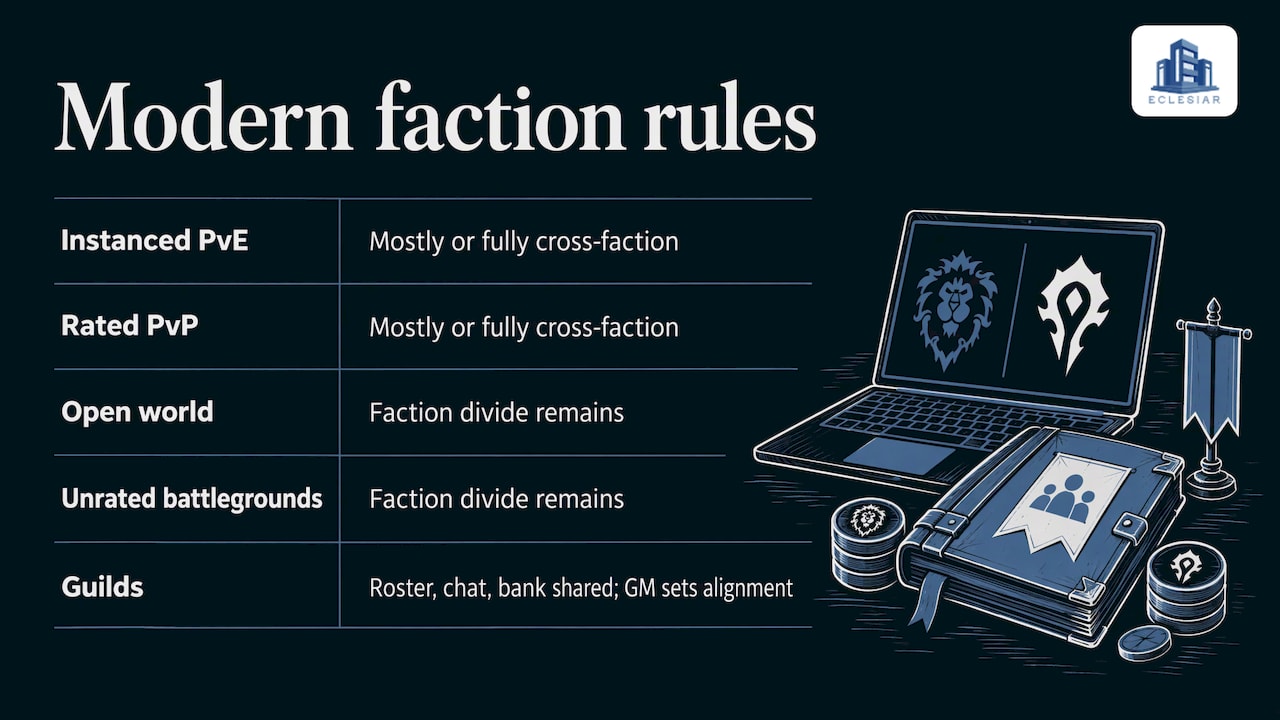
Less than it used to, but it has not vanished. The same history notes that the pandaren, introduced in 2012, were the first playable race able to choose either faction, and that cross-faction instanced groups arrived in 2022 and cross-faction guilds in 2023. A 2026 overview of the cross-faction rules says that in modern retail play, instanced PvE content and rated PvP are mostly or fully cross-faction, while the open world and unrated battlegrounds keep the divide. It also says Alliance and Horde characters can share a guild roster with unified chat and guild bank access, but the guild’s official faction alignment follows its Guild Master.
The practical advice from beginner guides is simple: if you play with friends, join the faction they are on, because faction decides where you play and who you play with.
Faction vs alliance side by side
| Question | Faction | Alliance |
|---|---|---|
| What is it? | A side, group or identity | An agreement between groups |
| How do you get in? | Usually chosen once, often tied to race or nation | Negotiated, offered, accepted |
| Can it change? | Rarely, often with a special mechanic | Yes, by design |
| Who controls it? | The game’s rules | The players or governments involved |
| What it shapes | Access, identity, default enemies | Cooperation, shared wars, trade, politics |
| In World of Warcraft | The Alliance and the Horde | The Alliance is also a coalition of states in lore |
Which one matters more in a strategy game
In a role-playing game where the world is scripted, the faction does most of the work. The story, the quests and the enemies are written in advance, so your side determines what you see.
In a strategy simulation driven by real players, the balance flips. A side or a country gives you a starting position, but what you actually do with it depends on agreements. The questions that decide whether you grow or get overrun are alliance questions:
- Who will defend your border if a rival attacks?
- Which partners will trade with you on terms that help your economy?
- Who will you back in an election, and who will back you?
- When a war objective changes, who coordinates the response?
These are social questions, and they have no scripted answer. That is why strategy players often say the community is the real game.
A worked example
Imagine two players start in the same country. Player A treats the country as an identity, plays alone, and responds to events one at a time. Player B joins a group of players, agrees to coordinate on war efforts, shares information about the market, and supports a candidate in a presidential race. Both are in the same faction, but Player B has an alliance, and the alliance is what multiplies their effect. When rivals appear, Player A is one voice, while Player B arrives with a plan.
Nothing about this requires special rules. It simply follows from a world where decisions come from people rather than scripts.
How to choose and use alliances well
Whether you are in a fantasy game or a political simulation, a few habits make alliances work:
- Define the goal first. Defense, economic growth, a political campaign and a war push each call for different partners.
- Match commitments to capacity. Promise only the support you can deliver, because an alliance fails fastest when a partner does not show up.
- Keep communication open. Agree where updates are shared, and check in after each big change to the rules.
- Read the update notes. Game changes can shift what a war, a market or a region is worth. Eclesiar publishes its changes in the open, for example patch notes for 11 to 18 October 2026, and earlier posts on war changes and a player survey.
- Review the partnership regularly. An alliance that no longer serves both sides should be renegotiated rather than left to decay.
Where this plays out in Eclesiar
Eclesiar is a free online strategy game for desktop and mobile browsers, with a persistent world that changes as players make decisions. You can lead a nation, manage an economy, trade on a player-driven market, run for president and take part in wars against real players. Alliances and rivalries influence the game, which makes the faction-versus-alliance distinction a practical one: where you stand is a starting point, and who stands with you shapes how far you go.
Because the game runs in a browser with no required download, you can keep up with a partnership from a phone as easily as from a desktop. That matters when a coalition needs a quick response.
Eclesiar: a place to build alliances
If the discussion above made you want to put it into practice, Eclesiar lets you start free. Core gameplay, from politics to the market to war, is available without paying, and optional packs are there if you want customisation. You can start at Eclesiar and find a community to play with.

Whether you are looking for a political role, an economic empire or a place on the front line, the first step is the same: join the world and meet the players already shaping it.
Our perspective
Most players meet the word “faction” in a game that decides their side for them. That is a good design for a scripted story, but it is not what we wanted to build.
In Eclesiar, we care about a world that evolves through what players decide, not through content written in advance. Alliances and rivalries drastically influence gameplay, and we think that is the more interesting form of identity: you are not only where you started, you are also who you stand with and what you build together.
That is why we talk with players about war changes, publish patch notes and run surveys. A persistent world works best when the people in it can see how the rules move and have a say in how they develop.
If you came here to understand the difference between a faction and an alliance, our answer is practical. Start where you are, then find the people you want beside you.
João Caldeira
FAQ
Is the Alliance a faction?
Yes. In World of Warcraft, the Alliance is one of the two main playable factions, alongside the Horde. The word also describes a coalition of states in the game’s lore, which is why the terms are easy to mix up.
What does faction mean in a game?
A faction is an organized group or side with shared goals, ideology or identity. It usually determines how your character relates to NPCs and other players, and which areas, quests or reputations you can reach.
Can you change factions in a game?
It depends on the game. In many, the choice is meant to be lasting, and changing it takes a paid or special service. In World of Warcraft, the pandaren race was the first that could pick either side, and cross-faction guilds and instanced groups have since reduced the practical impact of the choice, though the open-world divide remains.
Is an alliance permanent?
No. An alliance is an agreement, so it lasts as long as the partners keep it useful. In games driven by players, that is part of the appeal: alliances form, shift and end based on real decisions.
Which is better for a strategy game, a faction or an alliance?
They do different jobs. A faction gives you a starting identity, and an alliance gives you reach. In a persistent, player-driven strategy world, alliances usually decide how much you can achieve.
Sources
- Faction, Warcraft Wiki
- Alliance, Warcraft Wiki
- Horde, Warcraft Wiki
- Newbie guide: Starting areas, Warcraft Wiki
- Races and factions of Warcraft, Wikipedia
- World of Warcraft Cross-Faction Group Rules 2026
- How to Create a Character, Wowhead