

 العربية
 Deutsch
 Română
 Čeština
 Magyar
 Svenska
 Polski
 Hrvatski
 עברית
 Ελληνικά
 Português
 Português (Brasil)
 Slovenščina
 Српски
 Македонски
 Български
 Français
 Español
 Español (Colombia)
 Español (Argentina)
 Español (México)
 Català
 Türkçe
 Nederlands
 Italiano
 Bahasa Indonesia
 日本語
 简体中文
 繁體中文
 हिन्दी
 العربية (مصر)
 Shqip
 ไทย
 Русский
 فارسی
 Українська
 Filipino
 اردو

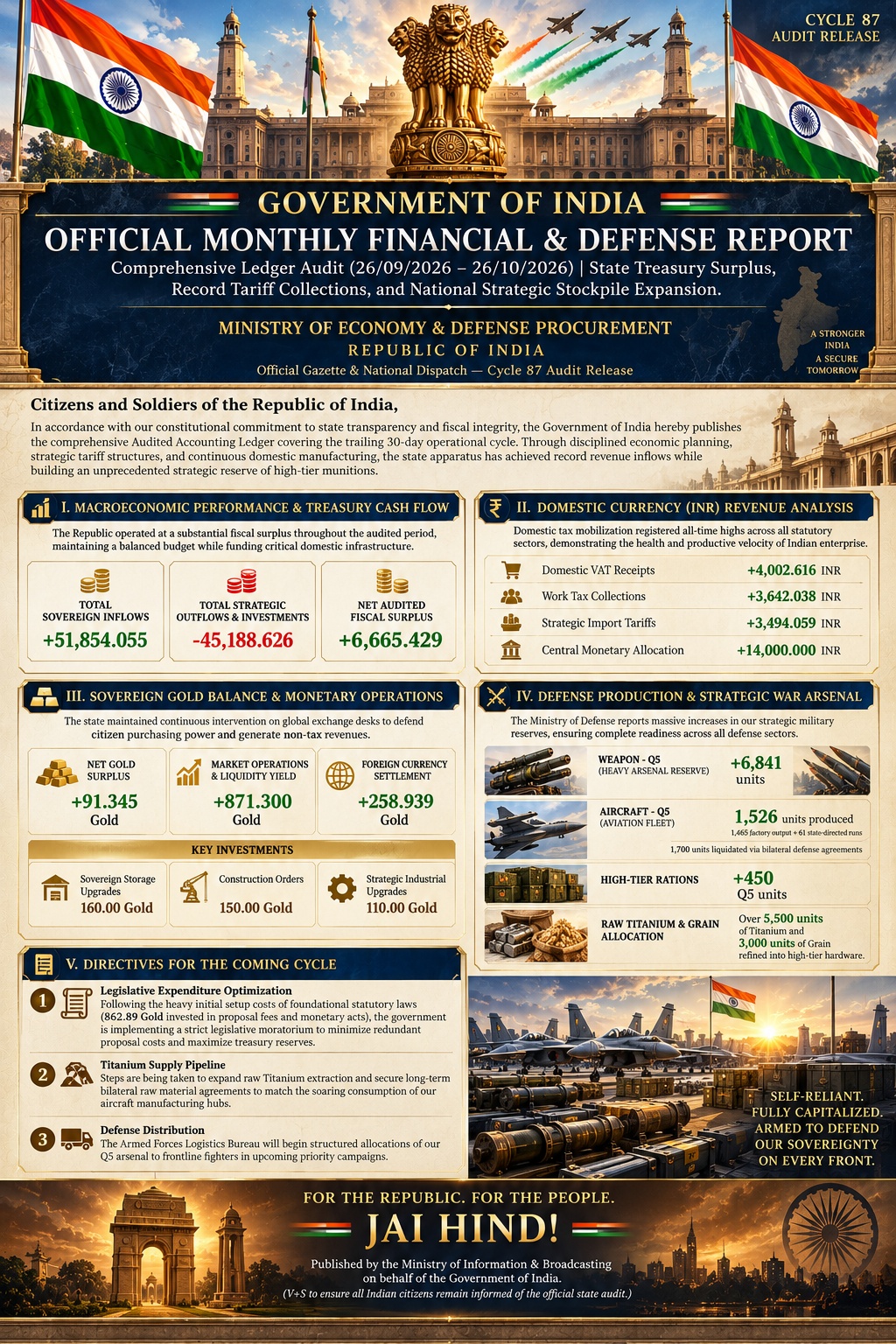
Treasury Performance, Revenue Collections, Strategic Stockpiles & Priorities for the Next Cycle
Reporting Period: 26 September 2026 – 26 October 2026
Issued by: Ministry of Economy & Defence Procurement
Publication: Official Gazette & National Dispatch — Cycle 87
Citizens and Soldiers of the Republic of India,
The Government of India hereby releases its financial and defence performance report for the 30-day operational period ending 26 October 2026.
The report summarises treasury inflows and outflows, domestic revenue collections, monetary operations, strategic investments, and changes in national defence stockpiles. The figures presented below are based on the government's reported ledger for this period.
The government's priorities remain clear: maintain fiscal discipline, strengthen domestic production, manage public resources responsibly, and build dependable strategic reserves for India's future requirements.
I. TREASURY PERFORMANCE & FISCAL POSITION
During the reporting period, the government recorded positive net treasury movement while continuing to fund industrial development, strategic storage, and market operations.
Total recorded inflows: +51,854.055
Total recorded outflows and investments: −45,188.626
Net treasury surplus: +6,665.429
The positive balance reflects the difference between recorded inflows and outflows during the period. Government spending continued to support productive capacity, strategic infrastructure, and national economic priorities.
The government will continue monitoring expenditure to ensure that future investments remain aligned with available resources and long-term national objectives.
II. DOMESTIC CURRENCY REVENUE & COLLECTIONS
Revenue collections across key domestic channels contributed to the government's financial position.
Domestic VAT receipts: +4,002.616 INR
Work tax collections: +3,642.038 INR
Import tariff collections: +3,494.059 INR
Central monetary allocation: +14,000.000 INR
These figures reflect recorded receipts and allocations during the reporting period. VAT and work-tax collections provide revenue from domestic economic activity, while import tariffs contribute to government income from cross-border trade.
The government will continue evaluating tariff policy and domestic taxation with the objectives of supporting Indian enterprise, maintaining predictable market conditions, and ensuring that fiscal measures remain economically sustainable.
The central monetary allocation is reported separately from tax collections because it represents a different type of financial inflow.
III. GOLD RESERVES & MONETARY OPERATIONS
The government continued its monetary and external-exchange operations during the reporting period.
Recorded net Gold surplus: +91.345 Gold
Reported market-operation yield: +871.300 Gold
Reported bilateral foreign-currency settlements: +258.939 Gold
Sovereign storage upgrades: 160.00 Gold
Construction orders: 150.00 Gold
Strategic industrial upgrades: 110.00 Gold
The market-operation figure should be interpreted according to the underlying ledger—particularly whether it represents gross proceeds, realised yield, or net profit after costs. Similarly, the bilateral settlement figure should be distinguished from the net treasury balance to avoid double-countin⁸g.
The government will continue pursuing disciplined monetary operations, careful liquidity management, and strategic investment while accounting for the costs and risks associated with market intervention.
IV. DEFENCE PRODUCTION & STRATEGIC STOCKPILES
The government continued to manage domestic production, procurement, and strategic inventory during the reporting period.
Q5 Ground Weapons
Reported net addition to sovereign reserves: +6,841 units.
Q5 Aircraft Weapons
Reported domestic production: 1,526 units, comprising 1,465 units of factory output and 61 units from state-directed production runs.
Reported units liquidated through bilateral defence agreements: 1,700 units.
Production and sales must be evaluated alongside opening inventory, procurement, transfers, and closing stock. The government will reconcile these figures to provide a complete inventory movement statement.
Q5 Food Supplies
Reported stockpile increase: +450 units.
Raw Materials
More than 5,500 units of Titanium and 3,000 units of Grain were reportedly allocated to high-tier production and related strategic requirements.
These figures demonstrate the scale of the government's reported production and stockpile activity. Future reports should distinguish production output, purchases, sales, transfers, and net inventory changes to provide a transparent picture of available reserves.
V. DIRECTIVES FOR THE NEXT REPORTING CYCLE
1. Expenditure Discipline
The government will review recurring legislative and proposal costs following the reported expenditure of 862.89 Gold on proposal fees and monetary acts. Further proposals will be assessed against their expected benefit, urgency, and fiscal cost.
2. Titanium Supply Security
The government will explore additional raw Titanium supply, including expanded extraction and bilateral procurement arrangements, to support industrial requirements and reduce production bottlenecks.
3. Defence Logistics and Distribution
The relevant government authorities will work towards structured allocation of Q5 stockpiles according to operational priorities, available reserves, and distribution requirements.
4. Transparent Financial Reporting
Future reports should distinguish gross revenue from net profit, transfers from newly generated income, and production from changes in inventory. These distinctions will improve financial oversight and support informed policy decisions.
VI. GOVERNMENT STATEMENT
The government's objective is to build a financially sustainable, industrially capable, and strategically prepared India.
A positive treasury balance is important, but responsible governance also requires accurate accounting, disciplined expenditure, reliable supply chains, and careful deployment of national resources.
The Government of India will continue working towards these objectives in the next operational cycle, with a focus on self-reliance, fiscal responsibility, domestic production, and the responsible management of defence reserves.
FOR THE REPUBLIC. FOR THE PEOPLE.
JAI HIND! 🇮🇳
Published by the Ministry of Information & Broadcasting on behalf of the Government of India.
Citizens are encouraged to review and share this official report to promote awareness of the government's recorded financial and defence activity.
