

 العربية
 Deutsch
 Română
 Čeština
 Magyar
 Svenska
 Polski
 Hrvatski
 עברית
 Ελληνικά
 Português
 Português (Brasil)
 Slovenščina
 Српски
 Македонски
 Български
 Français
 Español
 Español (Colombia)
 Español (Argentina)
 Español (México)
 Català
 Türkçe
 Nederlands
 Italiano
 Bahasa Indonesia
 日本語
 简体中文
 繁體中文
 हिन्दी
 العربية (مصر)
 Shqip
 ไทย
 Русский
 فارسی
 Українська
 Filipino
 اردو

THE AMERICAN RULE
The Official Market Gazette of the United States of America
SPECIAL WAR DISPATCH: AUSTRALIA RISES — INDEPENDENCE WITHIN REACH?
October 20, 2026 | International Conflict Edition
🇦🇺 AUSTRALIA'S HOUR OF RECKONING: CAN INDEPENDENCE BE WON ON THE BATTLEFIELD?
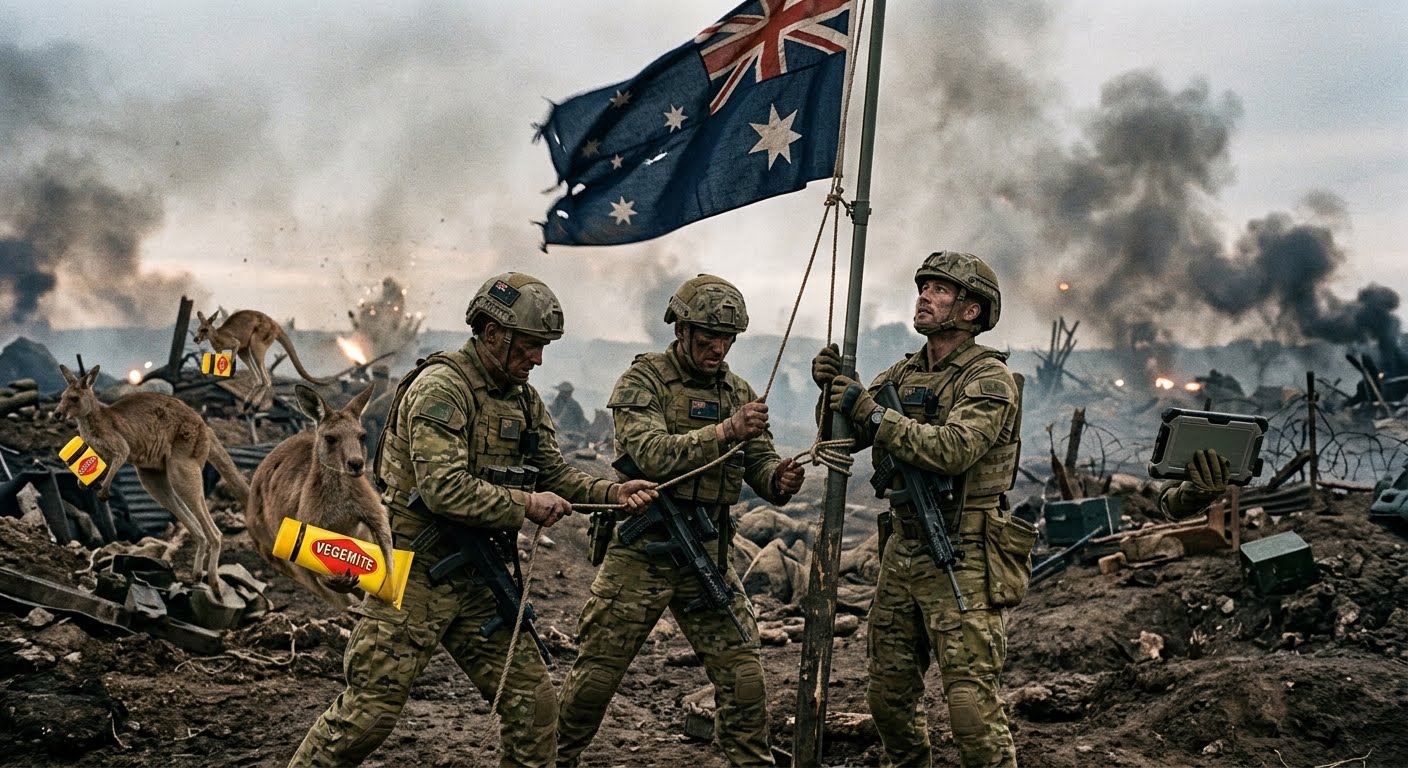
CANBERRA — A dramatic shift may be unfolding in Eclesiar. Australia is delivering a devastating performance against the United States in Canberra, raising a question that could reshape the Pacific balance of power: could Australia be on the path to regaining its independence from American and Chilean control?
The latest battlefield report shows Australia with approximately 3.61 million damage points, while the United States has recorded zero. The battle display awards Australia 100% of the progress, with the American side sitting at 0%.
These figures are a warning that cannot be ignored. If Australia's military momentum translates into a lasting victory, the consequences could reach far beyond a single battlefield. A nation seeking to break free from foreign control must first demonstrate that it can challenge the forces standing in its way.
For America, Canberra presents an uncomfortable strategic question. If Australia can dominate this engagement so thoroughly, how secure is the existing arrangement—and what would a renewed, independent Australia mean for the region?
THE PACIFIC BALANCE: AMERICA AND CHILE UNDER PRESSURE
Australia's potential return to independence must be viewed alongside the wider American military picture, including the United States' engagement with Chile at Puerto Montt.
There, American forces hold the advantage, with approximately 609,400 damage points against Chile's 336,900. The United States controls 64.4% of the displayed progress, while Chile holds 35.6%.
This presents a striking contrast with Canberra. America is ahead against Chile but has been completely outpaced by Australia in the displayed Australian battle.
The distinction matters. Military strength is not measured by a single result, and success in one theater does not guarantee control in another. If Australia continues to challenge American power while the United States remains committed to other engagements, the Pacific could become a much more complicated strategic environment.
Chile's position adds another dimension to the story. Chile does not independently establish the precise political or territorial arrangements governing Australia's status. Any claim that Australia has already escaped both American and Chilean control would therefore be premature.
Nevertheless, the battlefield raises a provocative possibility: the balance of power may be changing faster than the established powers would prefer.
🇺🇸 AMERICA'S GLOBAL WAR: VICTORIES AND WARNINGS
Australia's performance is only one part of America's wider military picture. The United States is also engaged in the Balkans, where the results are mixed.
Skopje: An Unresolved Confrontation
In Skopje, American and North Macedonian forces are listed against one another. The screenshot shows zero damage points for both sides.
There is no recorded damage advantage to declare, and no basis to claim that either side has won. The engagement remains a situation to monitor.
Puerto Montt: America Holds the Advantage
The battle against Chile remains more favorable for the United States. American forces lead 64.4% to 35.6%, with approximately two hours remaining on the displayed clock.
America has the upper hand here, but the result does not erase the warning from Canberra. A nation can lead on one front and face a serious strategic challenge on another.
The question for American leadership is whether it can maintain its advantages while responding to a potential shift in the Pacific.
🇲🇰 THE BALKANS: NORTH MACEDONIA'S RISE
While the Pacific raises questions about Australia's future, the Balkans remain a theater of intense competition.
At Neum, North Macedonia leads Croatia with approximately 11.07 million damage points to Croatia's 5.07 million, controlling 68.6% of the displayed progress.
At Bitola, North Macedonia's advantage over Greece is even more dramatic: approximately 13.92 million damage points against Greece's 969,500, giving North Macedonia 93.49% of the displayed progress.
Yet North Macedonia is not winning everywhere. At Gjirokastër, Serbia leads with approximately 425,700 damage points to North Macedonia's 51,400. Meanwhile, the engagement at Skopje shows no recorded damage for either side.
These results illustrate the volatility of Eclesiar's geopolitical landscape. Even a nation delivering overwhelming victories on some fronts can find itself under pressure elsewhere.
🇧🇬 BULGARIA GAINS GROUND AGAINST GREECE
At Burgas, Bulgaria leads Greece with approximately 2.05 million damage points against 634,700. Bulgaria holds 76.34% of the displayed progress, while Greece has 23.66%.
Bulgaria has established a substantial advantage.
Together with the situation at Bitola, this places Greece under pressure in two separate engagements. The outcome of these battles could further affect the regional balance of power.
⚔️ THE BATTLEFIELD AT A GLANCE
Battlefield | Leading side | Displayed progress |
|---|---|---|
Canberra: Australia vs. USA | Australia | 100% |
Puerto Montt: USA vs. Chile | United States | 64.4% |
Neum: North Macedonia vs. Croatia | North Macedonia | 68.6% |
Bitola: Greece vs. North Macedonia | North Macedonia | 93.49% |
Skopje: USA vs. North Macedonia | No recorded damage | 0–0 |
Gjirokastër: Serbia vs. North Macedonia | Serbia | 89.23% |
Burgas: Greece vs. Bulgaria | Bulgaria | 76.34% |
Percentages reflect the battle displays in the supplied screenshots, not independently confirmed final outcomes.
THE BIG QUESTION: IS AUSTRALIA'S INDEPENDENCE WITHIN REACH?
Australia's performance in Canberra is the headline for a reason. The displayed 100% progress and 3.61 million damage points against an American total of zero suggest a crushing battlefield advantage at the time of capture.
But battlefield dominance and political independence are not necessarily the same thing. The reports do not confirm whether the battle is an independence campaign, whether the displayed progress represents a final result, or whether Australia has already changed political status.
What they do show is a potential turning point worth watching.
If Australia is fighting to regain its independence, the current figures offer a powerful sign of momentum. If that momentum translates into a lasting political victory, the consequences could be significant for American influence and Chile's position in the Pacific.
For the United States, this is a moment for clear-eyed assessment. The question is not simply who has the larger reputation or the more ambitious claims. It is who can turn battlefield strength into a durable political outcome.
THE AMERICAN RULE'S VERDICT
America remains competitive in some theaters, including its engagement against Chile, but the battle in Canberra is a stark warning that American influence cannot be taken for granted.
Australia may be approaching an opportunity to reclaim its independence. That possibility remains unconfirmed, but the battlefield figures make it a story that deserves close attention.
Meanwhile, the Balkans continue to demonstrate that no regional power is invulnerable. North Macedonia is dominating some engagements, Serbia is leading in another, and Bulgaria has established a strong advantage against Greece.
The world of Eclesiar is being shaped by more than declarations and diplomatic claims. It is being shaped by the results on the battlefield—and by what nations are able to do with those results.
If Australia can turn its battlefield advantage into independence, Canberra may be remembered as the beginning of a new chapter in the Pacific.
The American Rule will continue monitoring Australia's status, the American and Chilean positions, and developments across Eclesiar's active battlefields.
THE AMERICAN RULE
For America. For the People. For the Nation.
Editor's note: This report is based on battlefield screenshots supplied on October 20, 2026. The possibility of Australian independence is presented as analysis, not as a confirmed political outcome. Damage totals and battle progress may have changed since capture.
