

 English
 العربية
 Deutsch
 Română
 Čeština
 Magyar
 Svenska
 Polski
 Hrvatski
 עברית
עברית Ελληνικά
 Português
 Português (Brasil)
 Slovenščina
 Српски
 Македонски
 Български
 Français
 Español
 Español (Argentina)
 Español (México)
 Català
 Türkçe
 Nederlands
 Italiano
 Bahasa Indonesia
 日本語
日本語 简体中文
简体中文 繁體中文
繁體中文 हिन्दी
 العربية (مصر)
 Shqip
Shqip ไทย
ไทย Русский
 فارسی
فارسی Українська
 Filipino
 اردو
اردو
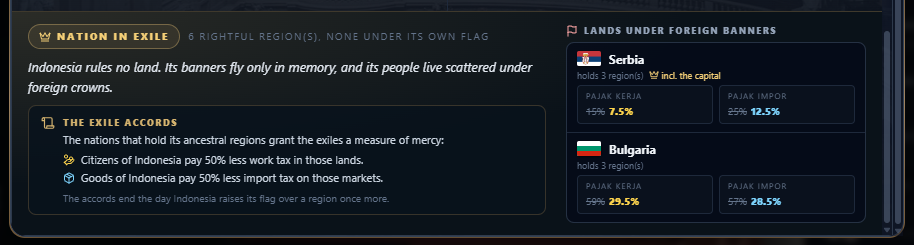
Image: Screenshoot anatomy tax load Eclesiar Indonesia
JACARTA, September 2026 - The geopolitical map of the motherland is in a condition that is not okay, all six Indonesian sovereignty areas are under the hands of foreign forces. Without any territory left under the national flag, the state status is now officially categorized as Nation in Exile Or government in exile.
Six of Indonesia's native regions are currently divided into two occupied zones. Serbia controls three regionals, which is Jakarta as well as the capital, Surabaya, and Makassar. While the other three regions, the regional Medan, the Ballikboard, and Jayapura, are under the occupation of Bulgaria.
In a situation like this, a special scheme is in effect known as the Treaty of Extermination or The Exile Records. This scheme provides fifty percent tax cuts for jobs and imports taxes for Indonesian people who are active in occupied areas by the Eclesiar system.
Serbs and Bulgaria Tax Overloads
The social economist of Eclesiar Economics and founder of the Nusantara Guard Party, Ozario, dissected the fiscally implication of this division of occupied territory for the well-being of the people.
According to Ozario's analysis, there was a very sharp economic inequality between the Indonesian people living in the Serbian and Bulgarian areas. Serbia implements a basic tax rate of fifteen percent and imports twenty-five percent. With the dismissal agreement, Indonesian citizens of the Jakarta regional, Surabaya, and Makassar only pay effective employment taxes of seven point five percent and imported taxes of twelve point five percent.
The opposite conditions occurred in the Bulgarian occupation zone. Bulgaria prizes basic tax work rates by fifty-nine percent and imports taxes fifty-seven percent. Although it's been cut in fifty percent, Indonesian Eclesiars in regional fields, Ballikkboard, and Jayapura still has to bear an effective labor tax of twenty-nine point five percent and imported tax of twenty-eight point five percent.
Ozario assessed that fiscally charged in the Bulgaria region was very strangling productivity. The people in the zone lost almost a third of their daily labor just to pay the tax cuts of the occupation.
Extinction Tax Collection
Ozario warned the entire community not to get caught up in the assumption that the Treaty of Extermination was a form of kindness in both countries.
He confirmed that the tax cuts were an automatic scheme The game system (Let's call it the United Nations) to keep citizens in occupied territory of foreign power from working completely. The most crucial thing is the fact that all of the tax funds accumulated, whether it's low rates in the Serbian zones or the high rates in the Bulgaria zone, still flow directly to the outerstate's coffers, not to the Indonesian national cash.
Thus, local economic activity under occupation indirectly strengthens Serbian and Bulgarian financial endurance.
Taking the fickal sovereignty Through the Resistance
At the end of the review, Ozario highlighted the main rule of the Treaty of Extermination, which is that this tax discount scheme would immediately stop once Indonesia had taken back at least one region and raised the flag again.
Ozario invites all citizens, political factions and military factions to immediately unify logistics in order to open the Resistance or Resistance War.. Taking back one region is the key key to stopping the flow of capital out of the country and returning tax management entirely to the prosperity of the people of Eclesiar Indonesia.
* NLP
