

 English
 العربية
 Deutsch
 Română
 Čeština
 Magyar
 Svenska
 Polski
 Hrvatski
 Ελληνικά
 Português
 Português (Brasil)
 Slovenščina
 Српски
 Македонски
 Български
 Français
 Español
 Español (Colombia)
 Español (Argentina)
 Español (México)
 Català
 Türkçe
 Nederlands
 Italiano
 Bahasa Indonesia
 日本語
日本語 简体中文
简体中文 繁體中文
繁體中文 हिन्दी
 العربية (مصر)
 Shqip
Shqip ไทย
ไทย Русский
 فارسی
فارسی Українська
 Filipino
 اردو
اردو
Two things in this one. First, the changes that came straight out of your post-2.0 survey answers — mostly about making the interface get out of your way. Second, the September 1st patch, which is the largest set of rule changes since 2.0 launched: the new nuclear system, a Library that remembers your nation's history, and a complete rework of how territory changes hands.
Part one: what the survey changed
The clearest message in the survey was that too many screens were showing you everything at once. So we went through them and cut.
Simplified screens
These modals have had information removed or moved behind a click, so the thing you opened them for is the first thing you see:
Training
Work
University
Political party listing
Military unit listing
Newspaper listing
Nothing was deleted from the game — the detail is still there, it just no longer competes with the action.
Labels on the buttons
The quick-link buttons now carry labels, and so do the side buttons on mobile. Icon-only navigation asks every new player to memorise a symbol set before they can do anything; now it simply says what it does.
Company management, rebuilt
The company management page has had a full revamp. It now has proper filters, and a new Employees tab, so hiring, firing and reviewing your workforce all happen on the same page instead of sending you around the interface.
Smaller things you will feel immediately
Storage: you can now switch entity directly from the storage screen — no more walking all the way out to a holding, a military unit or your country just to look at a different stock.
Chat: Discord links now become join buttons instead of raw URLs.
Equipment: improved colour contrast on the equipment background, so gear actually reads against it.
Combat: other players' damage is now shown live in training and tournament wars too, not only in regular wars.
Monetary market: a round of improvements.
There is more than fits here. The rest lands in our weekly 2.0 progress report on Saturday.
Part two: the September 1st patch
The new nuclear system
The nuclear rework we announced previously goes live on September 1st. If you have not read it yet, the full explanation is here: the nuclear system announcement.
On the day of release of new nuke system, we will REFUND all nukes into country storages and treasuries.
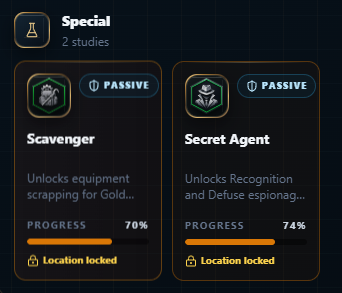
TODAY, and slightly ahead of schedule, we are also shipping the two new studies from that same announcement: Spy and Scavenger. Spy is deliberately early. It is the mechanic that counters nukes, and reaching it takes real time — releasing it before the nuclear changes rather than at same time means the counter-play may exists from the start of first wave of strikes.
The Library
Your nation now has a memory.
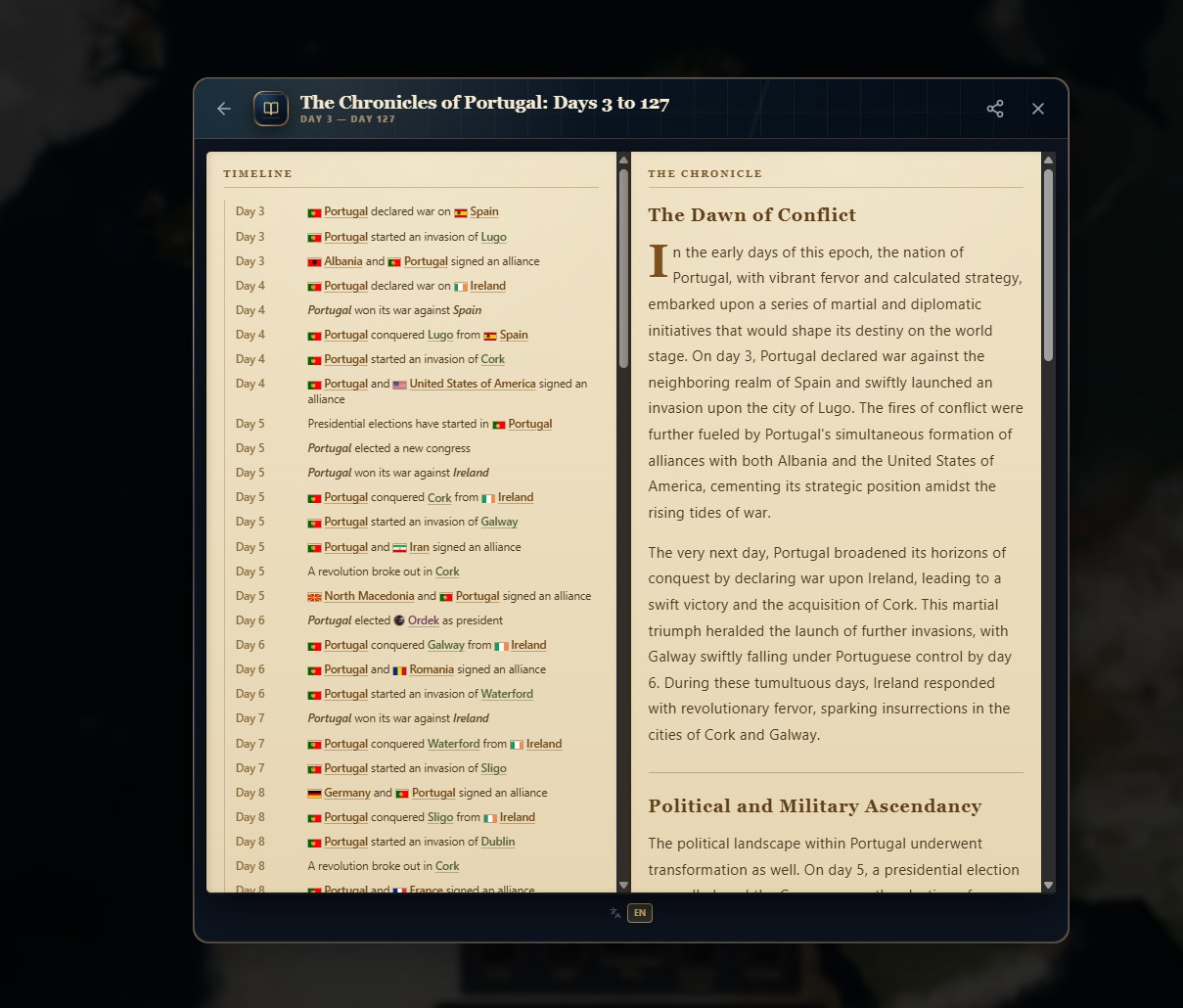
The Library is a new screen in the community menu. Inside it is a shelf for every nation with a history, and on each shelf stand that nation's Chronicles — numbered volumes, each covering one continuous era of its political and military life. Walk up to a shelf, pick a volume, and it opens as a book.
On the left page is the timeline: every war declared, alliance signed, region conquered, president elected, revolution and nuclear strike of that era, in order, dated by game day, with every nation, region and player linked so you can go and look at them.
On the right page is the chronicle itself — the era written up as a history, in prose, by a court historian who is given the facts and nothing else. It reads like a book because that is what it is meant to be.
A volume stays open while your nation keeps making history, and closes after 5 days of political quiet. While it is open the right page says so plainly: the history is still being written, and nobody sets down the final word on an era that has not finished happening. Once it closes, the timeline and the cast publish immediately and the written history follows shortly after.
Chronicles are written in English. A nation's president, vice-president or public relations can commission a translation into any other language for 200 gold from the treasury — and that is a public act: once paid, that translation becomes part of the Library for every player, permanently. Open any volume and you will see the full language bar, with the languages that already exist and the ones still waiting for somebody to fund them.
War and diplomacy
This is the big one. Three changes, and the third one changes how the map moves.
1. Fighting for a nation that is not yours
If you fight in a war for a side that is neither your own nationality nor an ally of it, your damage is reduced by 30%.
Training wars and tournament wars are unaffected — fight in those at full strength.
2. Alliances cost more while the guns are firing
The cost of an alliance proposal now scales with how much war the two nations are already in: three times more per active war, counted across both prospective allies.
Your nation's active wars | Their active wars | Alliance cost |
|---|---|---|
0 | 0 | normal |
1 | 0 | 3× |
2 | 1 | 9× |
So an alliance sworn in peacetime is cheap, and one bought in the middle of a three-front war is expensive. Diplomacy is easiest before you need it.
Nationality Change requests and exterdition also have their cost increased in same propotion
3. Conquest is now a war objective, not an invasion result
Winning an invasion no longer conquers a region. Conquest has moved up a level: it is now something you win the war for, not the battle.
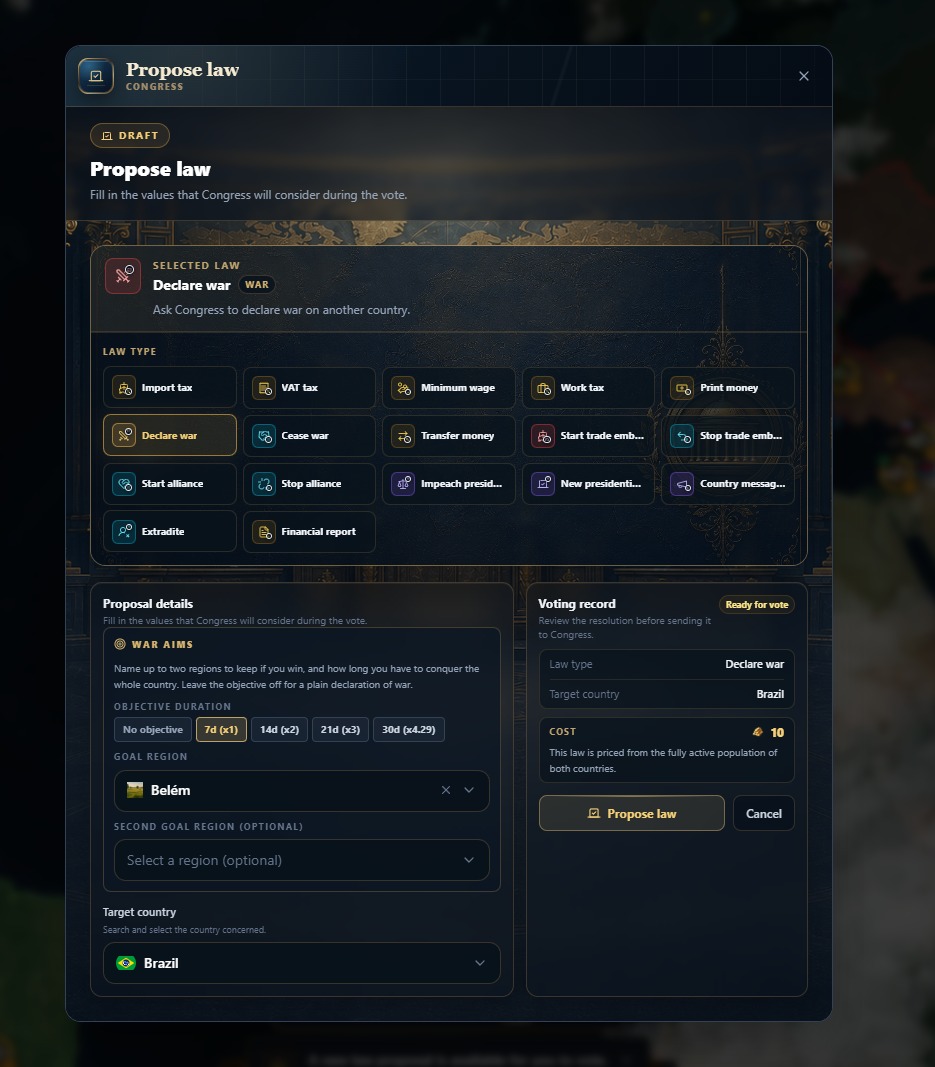
When you declare war, you now declare two more things with it:
A time limit — 7, 14, 21 or 30 days. The longer you give yourself, the more the war proposal costs.
A goal — one or two regions, maximum, chosen from the regions that nation currently holds.
To win, you must fully dominate the nation you declared on before your time runs out. Fully dominate means exactly what it sounds like: reduce them to zero regions.
If you manage it, you take the regions you named as your goal. Every other region you occupied during the war goes back to whoever held it before you arrived. If you fail — the clock runs out and they still hold ground — everything goes back.
Regions you take along the way are therefore occupied, not owned, until the war resolves. While a region sits occupied, its work tax splits: 80% to you as the occupier, 20% still going to the nation you took it from. You are collecting from ground you have not yet earned.
The non-aggression pact
When a war ends — won or lost, by conquest or by the clock — the two nations automatically enter a non-aggression pact for 7 days. Neither can declare war on the other during it.
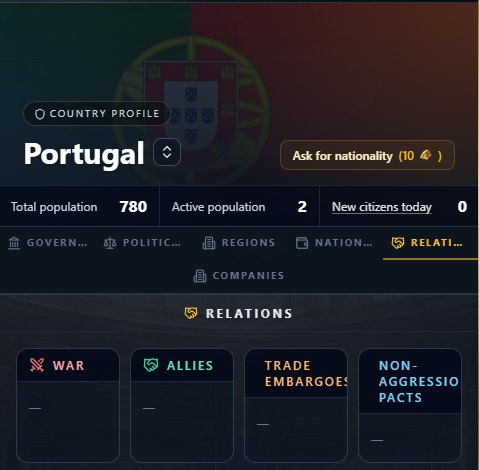
That week is deliberate. It is a breathing space between pushes: time to see what the map looks like now, count what you have left, talk to your allies and decide whether the next war is worth declaring. When the pact lapses, both sides are free to go again and push for another one or two regions.
Details worth knowing before you declare
A goal region you do not actually hold when the war resolves is forfeited. Winning the war is not enough; you have to still be standing on the prize.
You cannot start a new battle so close to your deadline that it could not finish in time. Plan the last day of a war, not just the first.
The defender can buy an objective of their own, paid from their treasury, naming up to two of the attacker's regions. It does not replace their defence — surviving to the deadline still ends the war — it means a war you started can cost you ground.
Total domination inside 7 days is genuinely hard against a large nation. The short tiers are for small targets; pick your time limit against the map, not against your budget.
4. Suing for peace
A cease-war bill is now an offer, not an ending. Your congress votes the terms; Refuse, or simply say nothing, and the war continues exactly as it was.
What you can put in a treaty:
Nothing, one, or both of the goal regions the attacker declared when the war began. Only those: a treaty settles the claim already on the table, it is not a general land market.
The length of the pact that follows — anywhere from 7 to 30 days. Seven is the floor, because seven is what losing gets you automatically, and peace should never buy less quiet than defeat.
Peace is available at any moment, and is now something you negotiate rather than something you declare, and the nation winning gets to name its price.
And as always: revolutions do not require a war. Nothing above changes that. A region can still be taken from within, with no declaration, no objective and no clock.
Closing
The survey changes are about respecting your time in the interface. The patch is about giving war a shape — a stated aim, a deadline, a cost for fighting under someone else's flag, and a week of enforced quiet afterwards to think about what you just did. And the Library is there so that when it is all over, somebody wrote it down.
Full details on everything else in the weekly 2.0 progress report, Saturday.