

 العربية
 Deutsch
 Română
 Čeština
 Magyar
 Svenska
 Polski
 Hrvatski
 עברית
עברית Ελληνικά
 Português
 Português (Brasil)
 Slovenščina
 Српски
 Македонски
 Български
 Français
 Español
 Español (Colombia)
 Español (Argentina)
 Español (México)
 Català
 Türkçe
 Nederlands
 Italiano
 Bahasa Indonesia
 日本語
日本語 简体中文
简体中文 繁體中文
繁體中文 हिन्दी
 العربية (مصر)
 Shqip
Shqip ไทย
ไทย Русский
 فارسی
فارسی Українська
 Filipino
 اردو
اردو
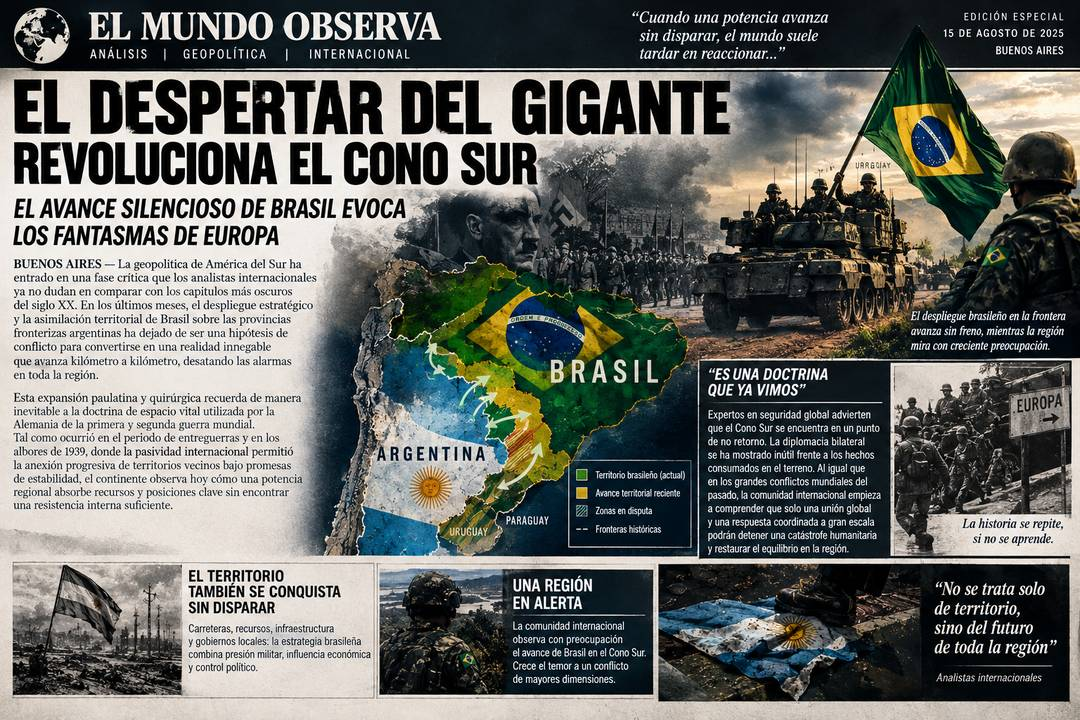
THE SILENCIOUS ENVIRONMENT OF BRAZIL
- South American geopolitics have entered a critical phase that international analysts no longer hesitate to compare with the darkest chapters of the 20th century. In recent months, Brazil & apos; s strategic deployment and territorial assimilation of the Argentine border provinces has ceased to be a conflict hypothesis to become an undeniable reality that moves a mile to a mile, unleashing alarms throughout the region. This gradual and surgical expansion inevitably recalls the doctrine of life space used by Germany in the first and second world war. As in the interwar period and at the dawn of 1939, where international passivity allowed the progressive annexation of neighbouring territories under promises of stability, the continent today observes how a regional power absorbs key resources and positions without finding sufficient internal resistance. The reports from the front describe an relentless military and logistics machinery. The occupation does not stop, and the fear that this advance will lead to a painful, prolonged and bloody war is increasingly founded. History has shown that such territorial ambitions are rarely held back by their own will; on the contrary, they often require a devastating human cost before finding their limit. Global security experts warn that the South Cone is at a point of no return. Bilateral diplomacy has proved useless in the face of the facts on the ground. As in the major world conflicts of the past, where free nations had to bury their differences to curb totalitarian machinery, the international community began to understand that only a global union and a large-scale coordinated response could stop a humanitarian catastrophe and restore balance in the region.
