العربية
 Deutsch
 Română
 Čeština
 Magyar
 Svenska
 Polski
 Hrvatski
 עברית
 Ελληνικά
 Português
 Português (Brasil)
 Slovenščina
 Српски
 Македонски
 Български
 Français
 Español
 Español (Colombia)
 Español (Argentina)
 Español (México)
 Català
 Türkçe
 Nederlands
 Italiano
 Bahasa Indonesia
 日本語
 简体中文
 繁體中文
 हिन्दी
 العربية (مصر)
 Shqip
 ไทย
 Русский
 فارسی
 Українська
 Filipino
 اردو
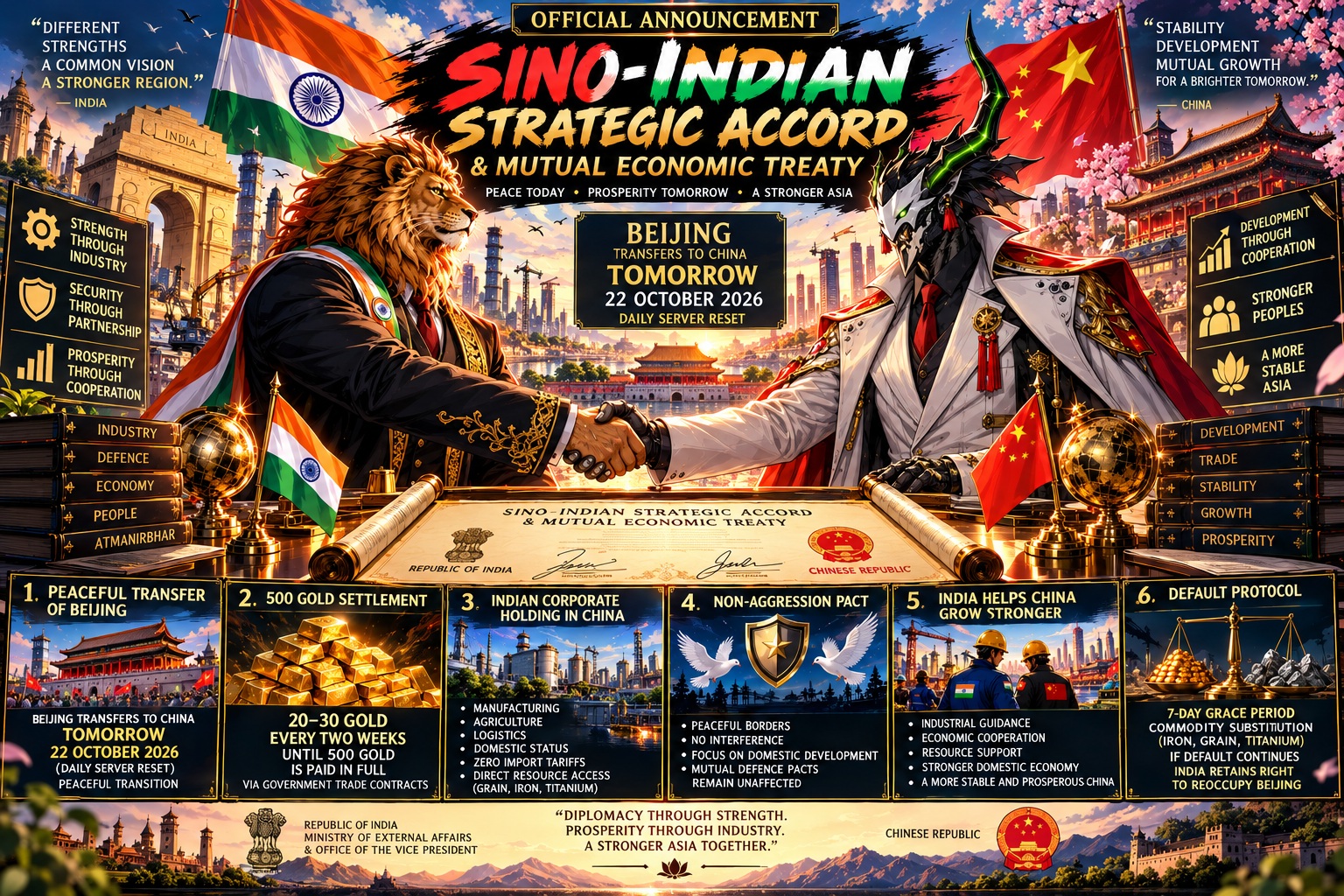
SINO-INDIAN STRATEGIC ACCORD & MUTUAL ECONOMIC TREATY
Published by: Ministry of External Affairs & Office of the President
Parties: Republic of India & Chinese Republic
Territory Concerned: Beijing
Date of Ratification: 21 October 2026
Execution Date: 22 October 2026 — Tomorrow's Daily Server Reset
A NEW CHAPTER IN SINO-INDIAN RELATIONS
Citizens of India and China, and fellow citizens of Eclesiar,
Following bilateral negotiations between the executive leadership of the Republic of India and the Chinese Republic, both governments announce the Sino-Indian Strategic Accord & Mutual Economic Treaty — an agreement designed to establish peaceful territorial transition, structured financial settlement, commercial cooperation, and mutual security.
At the scheduled daily server reset on 22 October 2026, administrative control of Beijing is intended to return to China under the agreed arrangements.
This agreement represents a strategic choice by both nations: replacing a costly territorial standoff with a framework for economic cooperation, financial predictability, and long-term regional stability.
I. THE TERMS OF THE ACCORD
1. Peaceful Transfer of Beijing
India will relinquish its administrative control over Beijing on 22 October 2026, enabling China to resume administration through a coordinated, peaceful transition.
2. The 500 Gold Settlement
China acknowledges a total settlement obligation of 500.00 Gold payable to the Indian National Treasury.
Installments: 20–30 Gold every two weeks.
Method: Direct in-game government trade contracts.
Duration: Until the full 500 Gold obligation is paid.
Both governments will maintain transaction records and confirm each completed installment.
3. Indian Commercial Presence in China
China agrees to facilitate an Indian Corporate Holding Company within Chinese territory, subject to applicable game mechanics and agreed registration arrangements.
The proposed cooperation includes manufacturing, agriculture, logistics, and access to locally available Grain, Iron, and Titanium. Domestic-market treatment and tariff exemptions will apply only where permitted by the game's mechanics and confirmed by both governments.
4. Non-Aggression and Border Stability
Both nations commit to a mutual non-aggression framework intended to reduce unnecessary conflict and preserve military resources. Each will respect the agreed arrangements while retaining the ability to protect its legitimate national interests.
II. INDIA'S COMMITMENT TO CHINA'S GROWTH
India does not seek a permanently weakened neighbour. A stable, productive China can contribute to a stronger and more prosperous region.
India will seek to help China build a stronger, more self-reliant economy through practical cooperation, subject to available resources and mutually agreed arrangements.
This cooperation will focus on:
Industrial development: Sharing experience in building sustainable domestic production chains.
Economic cooperation: Exploring mutually beneficial trade and commercial opportunities.
Resource support: Facilitating access to essential raw materials and industrial goods where feasible.
Long-term stability: Encouraging domestic production, economic resilience, and reduced dependence on costly foreign supplies.
Our objective is to build a partnership in which both nations can grow stronger while protecting their sovereignty and strategic interests.
III. DEFAULT AND ENFORCEMENT
Stage One — Seven-Day Grace Period
If China cannot make a scheduled Gold payment, it may request a seven-day grace period and propose an equivalent-value delivery of Iron, Grain, or Titanium through an in-game contract.
The quantity and valuation must be agreed by both governments. The outstanding obligation will be reduced only after India accepts and verifies the delivery.
Stage Two — Material Breach
If the installment remains unpaid and no agreed commodity settlement is completed within the grace period, the matter will constitute a material breach.
The affected party may invoke the treaty's enforcement provisions, including suspension of non-aggression commitments and review of the territorial arrangement. Any attempt to reoccupy Beijing remains subject to Eclesiar's territorial mechanics and circumstances at that time.
IV. STRATEGIC BENEFITS
For China
Peaceful restoration of Beijing.
Predictable financial installments.
Opportunities for industrial cooperation and economic development.
Greater flexibility to direct resources towards domestic priorities.
For India
Recurring settlement revenue to support national priorities, including Project Atmanirbhar.
Reduced territorial administration and defence commitments.
Potential commercial opportunities in China.
Greater flexibility to focus on domestic manufacturing and core territorial defence.
V. EXECUTION NOTICE
22 October 2026 — Daily Server Reset
Both governments intend to coordinate the following actions:
Transfer administrative control of Beijing to China.
Initiate the first Gold installment under the agreed payment arrangements.
Bring the non-aggression framework into effect.
Begin implementing the agreed commercial-cooperation measures.
The parties should confirm each step through in-game records.
A PARTNERSHIP BUILT ON STRENGTH
India seeks to convert a costly territorial commitment into financial compensation, commercial opportunity, and greater strategic flexibility, while supporting China's long-term development.
China gains a peaceful path to restoring Beijing and an opportunity to strengthen its economy. India gains a structured settlement and greater capacity to pursue its industrial and defence priorities.
The success of this accord will depend on transparency, timely payments, and respect for the commitments made by both governments.
Diplomacy through strength. Prosperity through industry. A stronger future through cooperation.
JAI HIND! 🇮🇳
Office of the President
Ministry of External Affairs
Republic of India