
 العربية
 Deutsch
 Română
 Čeština
 Magyar
 Svenska
 Polski
 Hrvatski
 עברית
עברית Ελληνικά
 Português
 Português (Brasil)
 Slovenščina
 Српски
 Македонски
 Български
 Français
 Español
 Español (Colombia)
 Español (Argentina)
 Español (México)
 Català
 Türkçe
 Nederlands
 Italiano
 Bahasa Indonesia
 日本語
日本語 简体中文
简体中文 繁體中文
繁體中文 हिन्दी
 العربية (مصر)
 Shqip
Shqip ไทย
ไทย Русский
 فارسی
فارسی Українська
 Filipino
 اردو
اردو
Ratification of the Maritime and Continental Stability Accord
A New Era of Regional Stability, Economic Cooperation, and Sovereign Independence
Issued jointly by the Executive Administrations of India and China
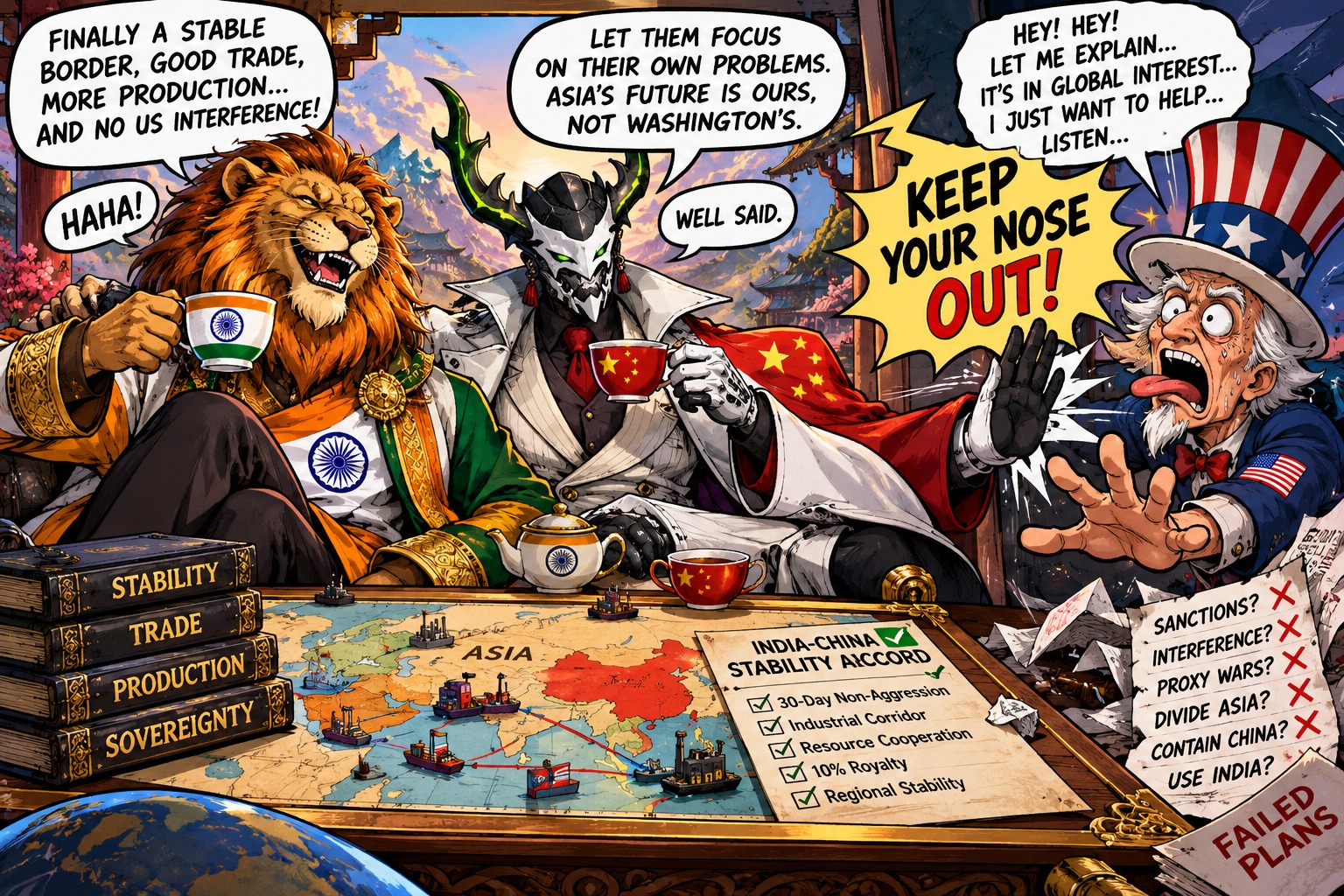
Following the successful conclusion of high-level diplomatic negotiations, the governments of India and China have formally ratified the Maritime and Continental Stability Accord, establishing a new framework for regional peace, economic cooperation, and mutual security.
This agreement marks a decisive step toward a more stable and economically integrated continent. At a time when global rivalries threaten international trade and regional security, India and China have chosen a path defined by strategic independence, industrial development, and the protection of their respective national interests.
Our message is clear: Asia's future will be determined by Asian nations, through their own decisions and agreements.
I. The 30-Day Continental Non-Aggression Framework
Both governments have committed to a binding 30-day regional stability framework designed to prevent hostile movements, unauthorized border changes, and military actions against each other's designated administrative territories.
Throughout this period, both administrations will prioritize de-escalation, territorial stability, and the protection of civilian populations and economic infrastructure.
This agreement provides an opportunity for both nations to concentrate on domestic development, strengthen administrative efficiency, and establish the foundations for lasting regional stability.
Peace is not a concession of strength. It is the exercise of sovereign judgment.
II. The Industrial Cooperation Corridor and Resource Royalty Framework
Under the newly established preferential trade arrangement, authorized industrial enterprises from both nations will be permitted to develop production and resource-extraction infrastructure within mutually approved partner territories, subject to the terms of the accord.
The framework establishes three principal objectives:
Industrial expansion: Develop new production facilities and strengthen supply chains across participating territories.
Employment and development: Create local employment opportunities, improve industrial capacity, and support regional economic growth.
Resource royalty contributions: Implement a mandatory 10% royalty on qualifying raw-material extraction, transferred to the designated national treasury under the agreed financial framework.
These arrangements are intended to transform economic cooperation into a practical instrument of stability, ensuring that industrial expansion supports national development and strengthens the participating economies.
Our partnership will be measured not merely by the resources we produce, but by the economic strength we build together.
III. A Firm Warning to the United States and External Powers
The governments of India and China reaffirm that their bilateral agreements are matters of sovereign decision-making and are not subject to approval by third-party governments.
We are aware of the risks posed by external interference, geopolitical pressure, and attempts to exploit regional disagreements for strategic advantage. Any allegations of foreign-sponsored destabilization must be assessed on the basis of credible evidence rather than speculation.
Nevertheless, our position regarding external intervention is unequivocal.
The United States and all other external powers are strongly advised to keep their hands off our bilateral affairs. Do not mistake diplomatic restraint for weakness, or regional cooperation for an invitation to interfere.
India and China will determine the terms of their own agreements, manage their own economic partnerships, and address their own regional interests through direct negotiations.
No foreign administration has the authority to dictate the terms of a sovereign agreement between our two nations. Attempts to manipulate territorial arrangements, disrupt legitimate commercial activity, or undermine this accord through coercive economic or diplomatic measures will be met with proportionate, coordinated, and lawful countermeasures.
Washington should therefore understand one fundamental principle: the era in which external powers could assume an unrestricted right to intervene in every regional arrangement is over.
We seek confrontation with no nation. However, we will not accept interference disguised as guardianship, pressure disguised as diplomacy, or economic coercion presented as international responsibility.
Respect our sovereignty, and we will respect yours. Attempt to undermine it, and you must be prepared to face the consequences of your own decisions.
IV. Preservation of Sovereign Economic and Industrial Strength
India and China recognize that long-term national strength depends on productive capacity, secure supply chains, responsible resource management, and resilient domestic institutions.
Through this accord, both governments intend to strengthen industrial output, safeguard strategic resources, promote stable commercial exchange, and reduce vulnerabilities arising from external economic pressure.
Our objective is not to destabilize international markets or undermine legitimate trade with other nations. It is to ensure that our economic development remains resilient, our strategic decisions remain independent, and our national interests cannot be subordinated to the preferences of outside powers.
No alliance, however powerful, should assume that its influence grants it unlimited authority over the economic choices of sovereign nations.
India and China will pursue cooperation where their interests align, preserve their independence where their priorities differ, and defend their legitimate interests against coercion.
V. A Message to the International Community
This accord should not be interpreted as a declaration of hostility toward the wider world. It is a declaration that regional stability is best achieved when nations respect one another's sovereignty and honor their commitments.
We invite all countries to pursue constructive engagement, fair trade, and peaceful diplomacy. We reject, however, the notion that cooperation requires submission or that economic partnerships must be conducted under the shadow of external pressure.
India and China have chosen dialogue over escalation, production over disruption, and sovereign decision-making over external dictates.
Our partnership stands on mutual interests, strategic calculation, and a shared commitment to protecting our respective national priorities.
The message to Washington and the wider international community is unmistakable: respect the accord, respect our sovereignty, and keep your hands off our bilateral affairs.
The future of this partnership will be decided by India and China—not by outside powers seeking to dictate its direction.
Issued jointly by the Executive Administrations of India and China
For Sovereignty. For Stability. For Economic Strength.