English
 العربية
 Deutsch
 Română
 Čeština
 Magyar
 Svenska
 Polski
 Hrvatski
 Ελληνικά
 Português
 Português (Brasil)
 Slovenščina
 Српски
 Македонски
 Български
 Français
 Español
 Español (Colombia)
 Español (Argentina)
 Español (México)
 Català
 Türkçe
 Nederlands
 Italiano
 Bahasa Indonesia
 日本語
 简体中文
 繁體中文
 हिन्दी
 العربية (مصر)
 Shqip
 ไทย
 Русский
 فارسی
 Українська
 Filipino
 اردو

🇮🇳 GOVERNMENT DIRECTIVE
National Labour Realignment: Work Tax Increased to 20%
Issued by: Office of the Vice President & Ministry of Economy, Republic of India
To: All Factory Owners, Corporate Directors, Business Managers, and Citizens of India
Effective: Immediately
1. A Necessary Step to Restore Economic Stability
Fellow Citizens and Business Leaders of India,
Over the past week, the Government has made every reasonable effort to address the growing imbalance in our domestic labour market through cooperation, consultation, and voluntary compliance.
Official notices were issued, the economic pressures facing domestic producers were explained, and employers were urged to maintain daily wage offers within a sustainable range of 10.00–15.00 INR, with 20.00 INR as the maximum recommended limit.
Our objective was straightforward: to protect the profitability of Indian businesses, preserve domestic production, and ensure that workers continue to have access to reliable employment without unnecessary government intervention.
Unfortunately, these voluntary appeals have not achieved the required result. Excessive wage offers, in some cases reaching 25.00–35.00 INR or more per day, continue to distort the labour market and place considerable pressure on domestic producers.
When wage competition threatens the viability of essential industries, the Government cannot remain a passive observer. Responsible economic governance requires decisive action.
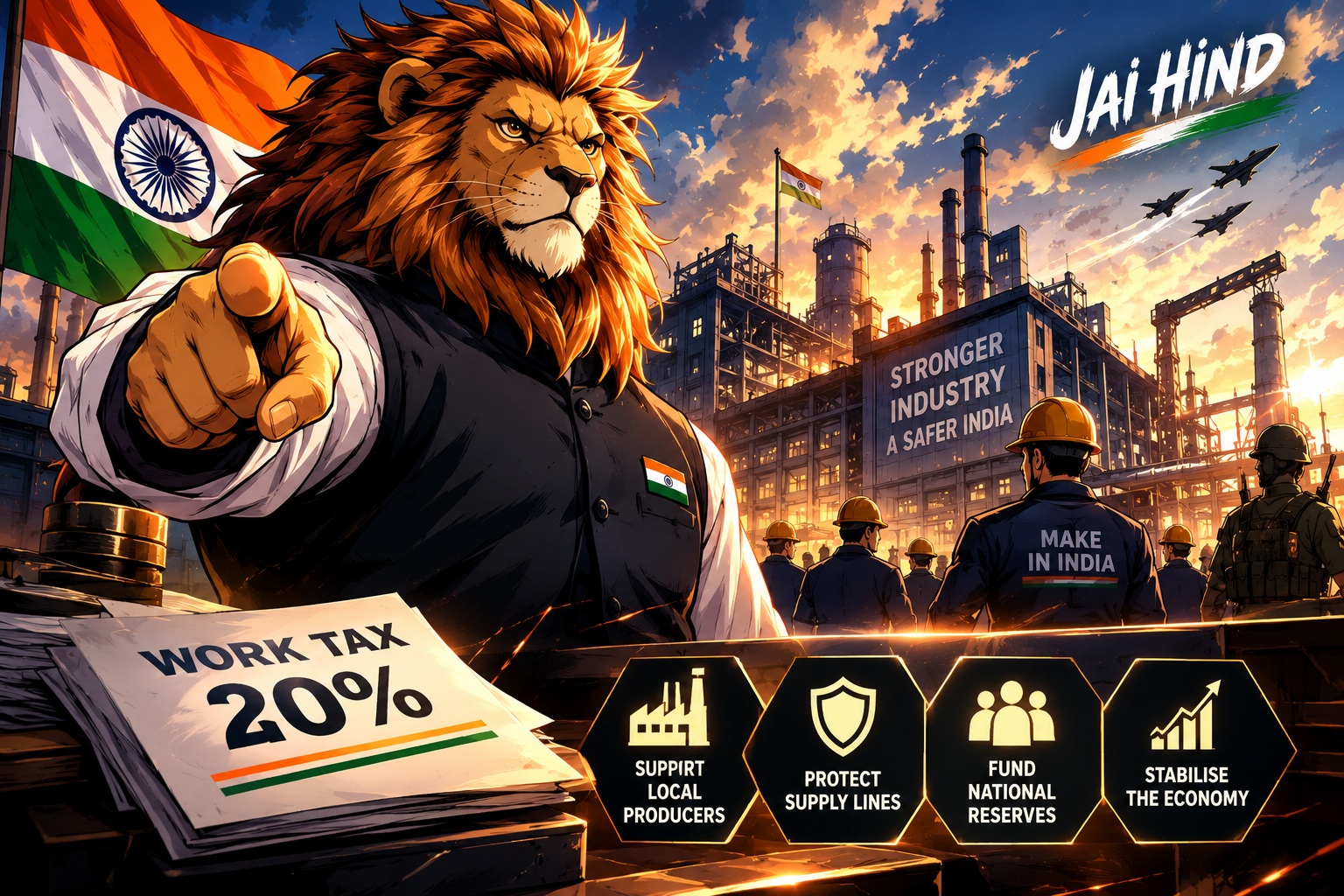
2. The Policy Decision: National Work Tax Increased to 20%
Following a vote in Congress, the Government has approved an increase in the National Work Tax from 10% to 20%.
This measure represents a targeted fiscal adjustment intended to discourage unsustainable wage competition while strengthening the financial capacity of the Indian state.
The revised rate will direct a larger share of payroll-related tax revenue into the National Treasury, supporting national reserves and essential government priorities.
3. Key Objectives of the Adjustment
A. Restoring Fairer Market Conditions
Excessive wage offers can place smaller producers at a disadvantage, particularly when their profit margins are limited. The increased Work Tax is intended to reduce the fiscal advantage of unsustainable wage competition and encourage employers to consider the long-term viability of their operations.
B. Defending Domestic Manufacturing
India's factories are essential to the production of food, raw materials, and military equipment. If domestic producers cannot operate sustainably, production may decline, local employment opportunities may disappear, and dependence on foreign imports may increase.
Protecting domestic industry is therefore not merely a business concern; it is a matter of national economic resilience.
C. Strengthening National Reserves
Additional revenue collected through the revised tax will help strengthen the National Treasury and support strategic priorities, including:
Maintaining reserves of state-owned Q-tier consumables and weapons.
Supporting emergency supply requirements for active frontline operations.
Improving the Government's capacity to respond to economic and monetary-market pressures.
These priorities will be pursued in accordance with the Government's broader fiscal and strategic requirements.
4. Why Government Intervention Became Necessary
The Government recognises that higher wages can benefit individual workers. However, wage offers that cannot be sustained by the underlying economics of production may create wider problems for the economy.
When labour costs rise beyond what factories can reasonably support, employers may reduce hiring, suspend production, or close their facilities altogether. In such circumstances, short-term wage gains can be followed by fewer jobs, weaker domestic supply, and greater reliance on imports.
The Government initially sought to address these risks through voluntary coordination rather than taxation. Employers were given advance notice and an opportunity to align their wage offers with the recommended guidelines.
That opportunity was not sufficient to restore the desired balance.
The increase in Work Tax is therefore a policy response to continued market distortions—not a rejection of fair wages or legitimate business growth.
5. The Government's Position Going Forward
The Government will continue to monitor labour-market conditions, regional production, employment availability, and the growth of the National Treasury.
The 20% Work Tax will remain in effect while the Government evaluates whether market conditions are moving towards a more sustainable balance.
If employers demonstrate responsible coordination, wage offers become more consistent with sustainable production costs, and domestic industry regains stability, the Government remains prepared to reconsider the tax rate through the appropriate legislative process.
Our objective is not to permanently restrict commercial activity. It is to ensure that India's economic growth rests on a stable and productive foundation.
6. A Collective Responsibility
India's economic strength depends on the ability of workers, employers, and the Government to act with a shared sense of responsibility.
We call upon all factory owners and business managers to review their current job listings, assess their production costs, and adopt wage structures that support sustainable operations.
We also encourage citizens to support domestic producers and recognise the importance of maintaining reliable national supply lines.
Strong businesses. Sustainable wages. Secure employment. A self-reliant India.
Let us work together to protect our industries, strengthen our reserves, and build a more resilient national economy.
Work sustainably. Protect domestic manufacturing. Stand with India.
JAI HIND!
Office of the Vice President
Ministry of Economy
Republic of India