By The Capital

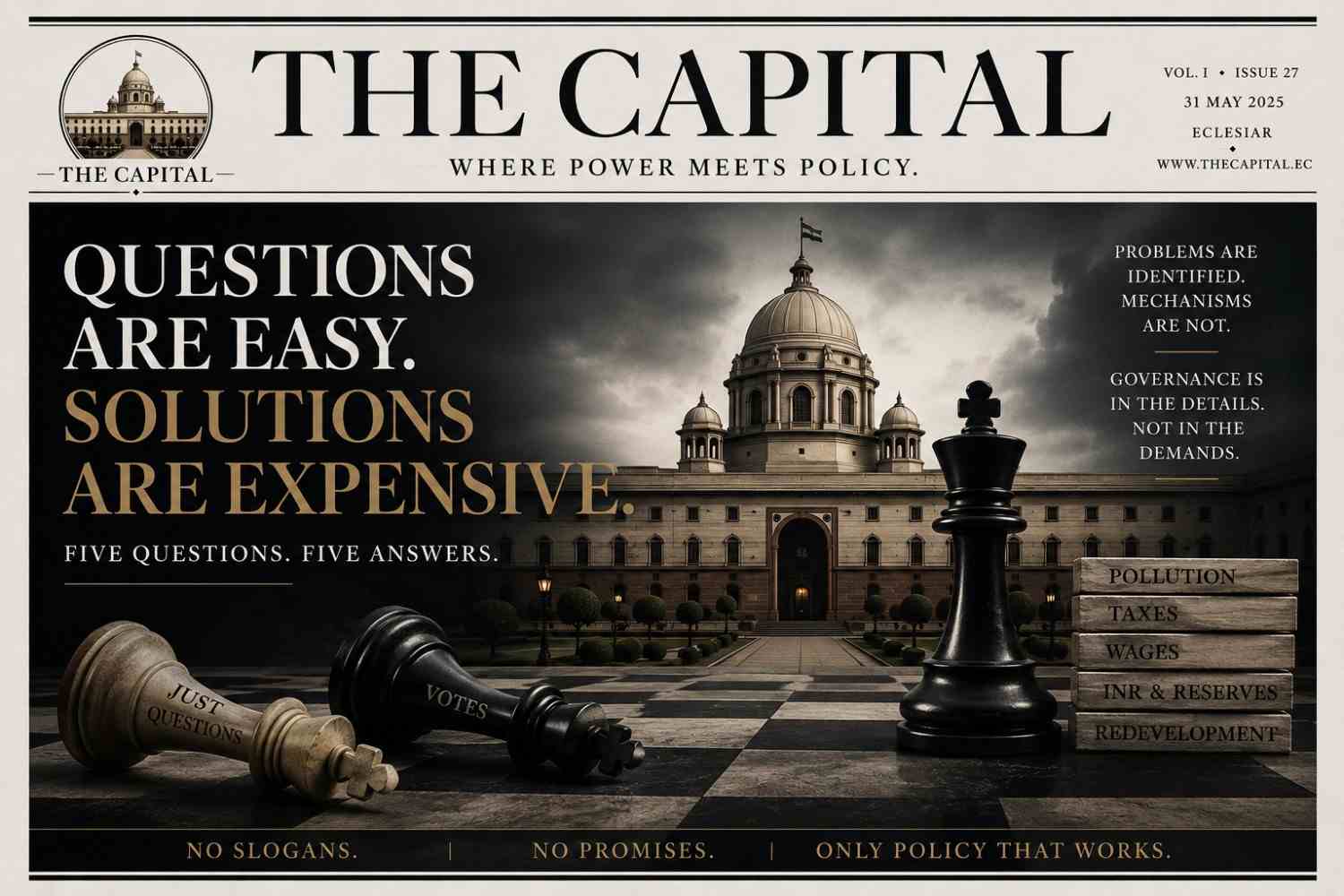
The opposition has raised five questions about India's future.

And they are legitimate questions.

Pollution. Taxes. Wages. Currency. Regional development.

These are issues any government should be prepared to answer.

But there is another side to the political equation.

If an opposition asks the government to explain its plan, voters are entitled to ask the opposition the same thing.

Not because the questions are wrong.

Because the questions are only the beginning.

The difficult part is turning them into policy.

So let's examine them.

1. POLLUTION

This is perhaps the most important issue raised in the article.

India's pollution levels are a serious concern. The question of what the government intends to do is therefore entirely reasonable. The ongoing Pirates event has actually aggravated the situation.

But a policy question remains unanswered:

What should actually be done first?

Which regions should be prioritised?

Which industries should face tighter restrictions?

How can pollution be reduced without unnecessarily damaging production?

How should the economy transition when economic activity and pollution are still closely connected?

These are not minor details.

They are the policy.

Saying that pollution must be reduced establishes the objective.

A credible solution must establish the sequence, mechanism and trade-offs.

Questions can identify a problem.

Mechanisms determine whether the problem gets solved.

2. TAXES

The tax argument deserves a closer look because, in this case, part of the proposed direction is already being pursued.

The opposition calls for lower VAT and higher import duties.

The import-duty increase has already passed at 13%.

And a bill proposing a reduction in VAT from 13% to 10% has already been tabled.

So one of the opposition's stated demands is already moving through Congress.

That doesn't make the proposal right or wrong.

It changes the question.

The important debate is now about economic consequences.

Will lower VAT stimulate demand sufficiently?

Will higher import duties strengthen domestic production?

Will consumers ultimately bear some of the additional cost?

And how will the government balance revenue, consumption and domestic industry?

Those are the questions worth debating.

Because economic policy is rarely about whether something sounds desirable.

It is about what happens after it is implemented.

3. WAGES

Low wages are another legitimate concern.

The opposition proposes minimum wages.

But minimum wages raise a second question:

Where does the additional income come from?

India currently has 2,814 citizens, with only 51 active citizens in the current figures.

That makes labour participation an important part of the discussion.

Increasing employment.

Increasing production.

Increasing demand for workers.

These can create the conditions in which wages rise sustainably.

A minimum-wage law can establish a floor.

But it cannot create businesses, jobs or demand for labour by itself.

That doesn't make minimum wages ineffective.

It means wage policy cannot be separated from employment policy.

A number can be legislated.

The economic activity supporting that number cannot.

4. THE INR

The article also raises concerns about currency creation, reserves and inflation.

Again, these are serious issues.

But "stabilise the INR" is an objective, not yet a complete policy.

How much currency should be issued?

What spending should be reduced?

How should reserves be used?

What level of monetary expansion is sustainable?

What trade-offs would accompany those decisions?

There may be several legitimate answers.

But without specifying the mechanism, the objective remains difficult to evaluate.

And that distinction matters.

Everyone can agree on the destination.

The political debate begins when we discuss the route.

5. JALANDHAR AND BANGALORE

The opposition also asks how Jalandhar and Bangalore should be redeveloped.

That is a useful question.

But redevelopment should begin with the economic purpose of the development.

Jalandhar has approximately 46% pollution, while Bangalore is above 55%.

Their conditions are different.

Their strategies may therefore need to be different as well.

Where can productivity increase?

Where can employment be created?

Where would regional incentives attract investment?

Where should infrastructure be expanded first?

The objective should not simply be to build more.

It should be to build where the economic return justifies the investment.

Infrastructure should support productive activity—not become the substitute for it.

AND THEN COMES THE VOTE.

After raising five questions for the government, the article asks citizens to vote for VP Rajinder Kumar and "give them a chance."

There is nothing unusual about that.

Oppositions exist to challenge governments and present themselves as alternatives.

But elections create an important symmetry.

The government must answer to voters.

So must the opposition.

If the incumbent is expected to explain how it will address pollution, taxation, employment, monetary policy and regional development, voters can reasonably expect the alternative to explain how it would address those same problems differently.

Not necessarily with identical policies.

Not necessarily with perfect certainty.

But with enough detail for voters to evaluate the choice.

Because governing is not simply recognising a problem.

It is deciding what comes first.

What comes second.

What it will cost.

What must be sacrificed.

What must be protected.

And what consequences follow from those decisions.

The opposition has raised five important problems.

It has asked the government for five answers.

It has also asked voters for their support.

The next step is equally important:

What are its own five answers?

That is not an argument against the opposition.

It is the standard by which any political alternative should be judged.

Anyone can ask:

"What is your plan?"

The more difficult question is:

"What is yours?"

And that is where political debate becomes useful.

Not when one side asks questions.

Not when the other side makes promises.

But when both are required to explain what they intend to do, how they intend to do it, and what they are prepared to accept in return.

Because voters deserve more than a choice between two sets of promises.

They deserve a choice between two credible mechanisms for solving the same problems.

The Capital

Where Power Meets Policy.