

 English
 العربية
 Deutsch
 Română
 Čeština
 Magyar
 Svenska
 Polski
 Hrvatski
 עברית
 Ελληνικά
 Português
 Português (Brasil)
 Slovenščina
 Српски
 Български
 Français
 Español
 Español (Colombia)
 Español (Argentina)
 Español (México)
 Català
 Türkçe
 Nederlands
 Italiano
 Bahasa Indonesia
 日本語
 简体中文
 繁體中文
 हिन्दी
 العربية (مصر)
 Shqip
 ไทย
 Русский
 فارسی
 Українська
 Filipino
 اردو


Citizens of Eclesiar,
Nuclear production now costs 50% less than the previous recipe, with the same destruction rules. We are also preparing a tournament capacity change so that growing participation creates more competitions and more prize pools.
Nuclear Costs: Before, Latest Patch and Now
You asked how the price of a nuke compares with what it destroys. To make that comparison clear, we are showing all three versions: Before is the original model, Latest patch is the preceding nuclear overhaul, and Now is the new production recipe. “Latest patch” here refers to the previous nuclear balance, not the date of our most recent weekly article.
The figures below are the base cost of one nuke, before country modifiers.
Resource | Before | Latest patch | Now |
|---|---|---|---|
Gold | 30 | 750 | 375 |
Iron | 100 | 2,500 | 1,250 |
Titanium | 200 | 5,000 | 2,500 |
Oil | 500 | 12,500 | 6,250 |
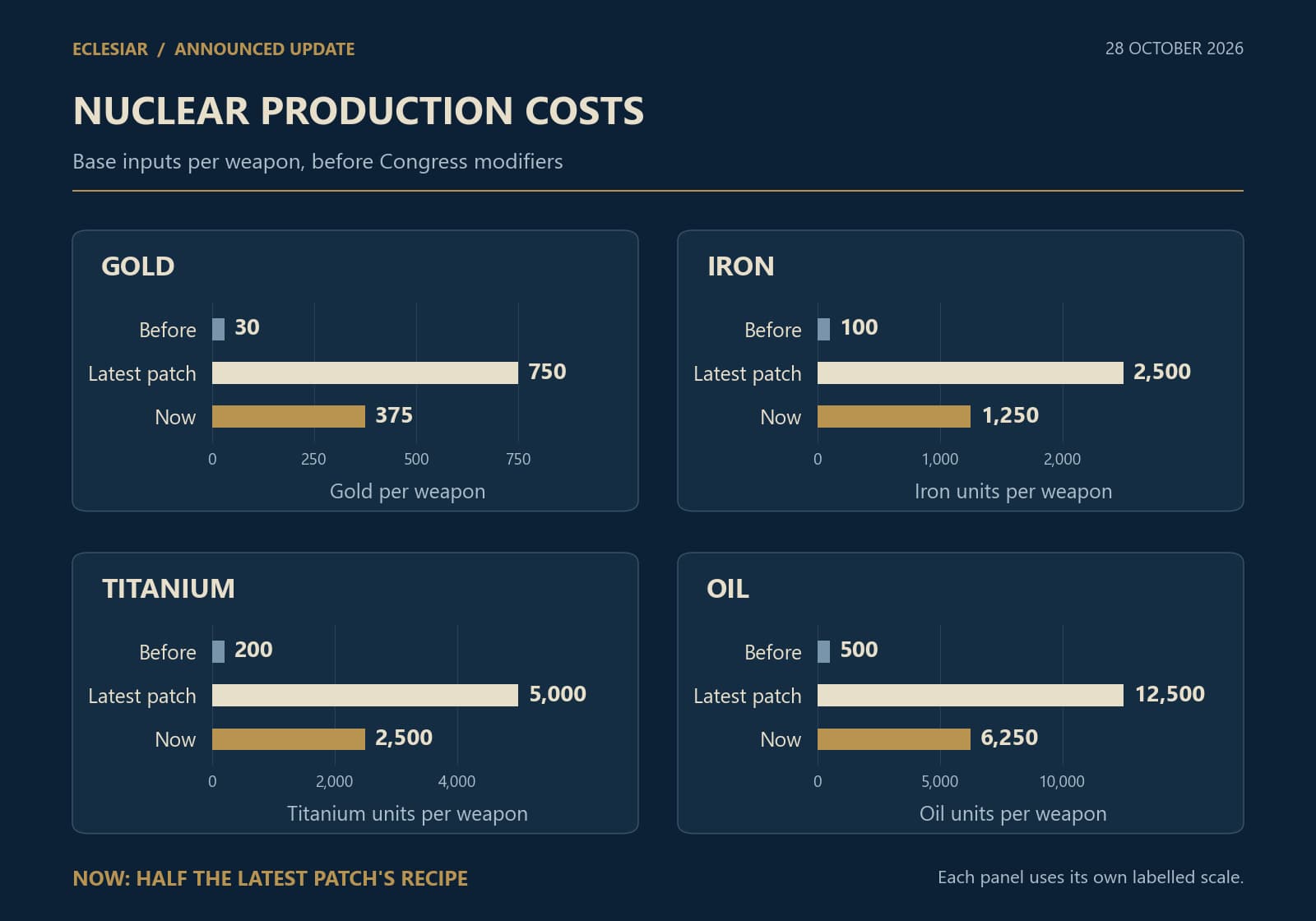
Every input is halved compared with the previous recipe. The three base recipes are 1×, 25× and 12.5× the original quantities. Gold and material units are shown separately; they are not interchangeable measures of value.
What Changed in Destruction?
The original nuke made two random attempts to remove one building level in the target region. It chose among the Hospital, Military Base, Production Fields and Industrial Zone. A building type could be selected twice, and selecting an absent or level-zero building could waste a hit. There was no connected-region building damage. The old Centralism effect could add a third hit; our comparison excludes ideology effects.
The preceding nuclear overhaul changed the effect substantially:
Target region: every building is reduced to level zero, including special or event buildings.
Directly connected regions: each loses one level from one randomly selected standing building. Regions with no standing buildings have nothing to lose.
Today's price reduction keeps those effects. It changes the production recipe, not the power of a strike. Existing stockpile effects and launch restrictions also remain in place.
Cost Versus Destruction: A Concrete Example
Consider a target containing exactly four buildings: a level-5 Hospital, Military Base, Production Fields and Industrial Zone, with no other standing buildings. Count only the levels removed in that target, with no ideology modifiers. Neighbouring damage and stockpiled weapons are excluded.
In this example | Before | Latest patch | Now |
|---|---|---|---|
Target building levels removed | 2 | 20 | 20 |
Gold per target level removed | 15 | 37.5 | 18.75 |
Raw-material units per target level removed | 400 | 1,000 | 500 |
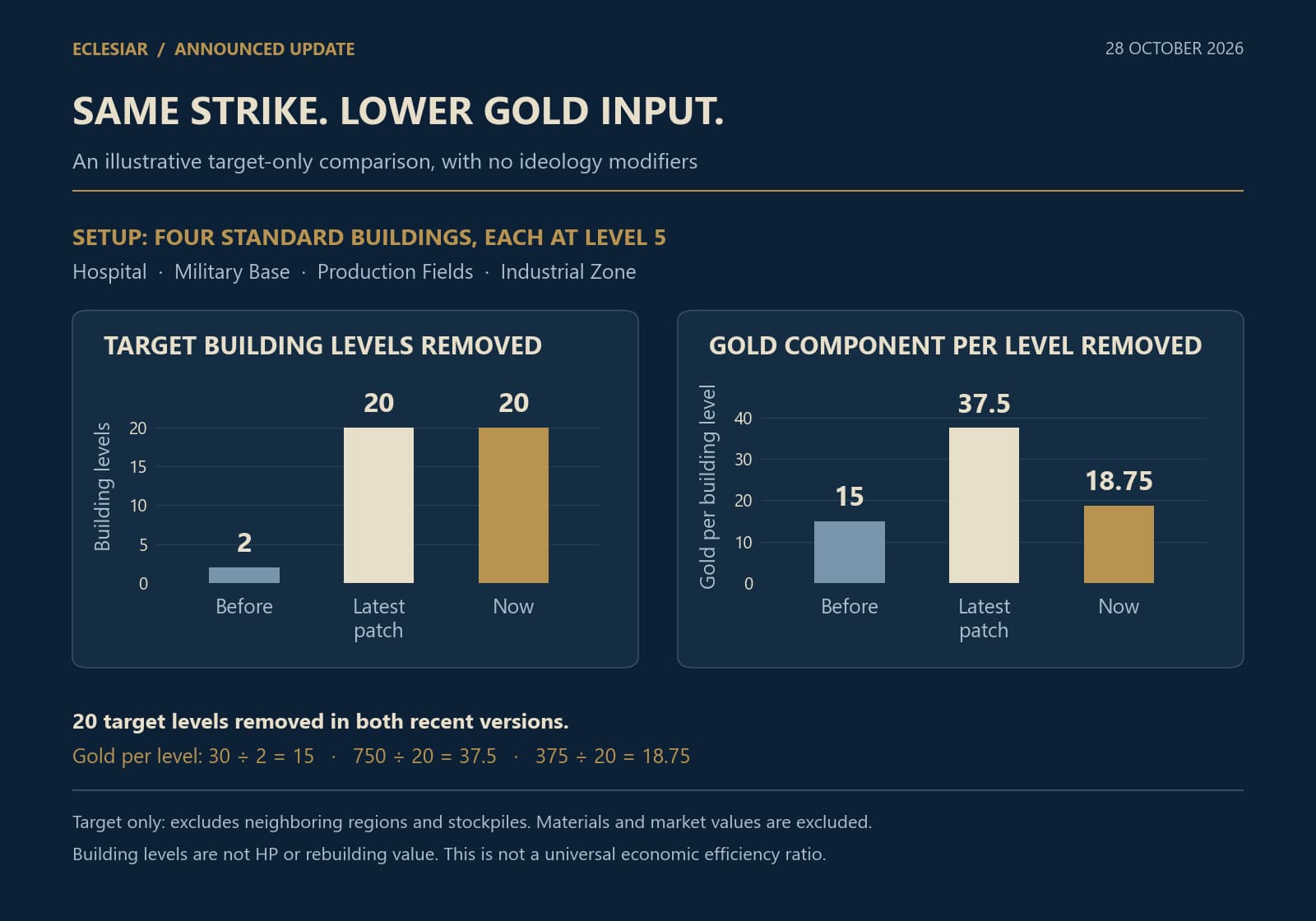
In this example, the new recipe halves the cost per level removed compared with the preceding nuclear patch. It is still 25% above the original recipe per level removed in this particular scenario, while a single strike removes 20 target levels rather than two. The current connected-region effects are additional and are not counted in this chart.
This is an illustration, not a fixed damage multiplier. Results depend on the buildings and their levels, connected regions and applicable modifiers. Building levels are not HP or equal rebuilding costs. The Gold figure is only the Gold component; raw-material counts are quantities, not their market value.
Production Details
Country modifiers still apply. At full current Centralism representation in Congress, the 20% discount brings the recipe to 300 Gold, 1,000 Iron, 2,000 Titanium and 5,000 Oil.
Base timings are unchanged: 48 hours to assemble and eight hours of flight, before applicable modifiers.
The new price applies to new production. Existing weapons and already-paid production orders are not repriced or refunded by this recipe change.
Growing Tournaments: 70 Teams per Instance
As Eclesiar grows, larger tournaments are exposing new issues. We are introducing a limit of 70 teams per tournament instance, with additional instances of the same tournament running in parallel when needed.
Reaching 70 teams will not shut the door on the next valid registration. We will create enough instances for all valid teams and distribute them as evenly as possible. The limit applies to each instance, not to the total number of teams that can take part.
Registered teams | Parallel instances | Teams in each instance | Full prize pools |
|---|---|---|---|
70 | 1 | 70 | 1 |
71 | 2 | 36 + 35 | 2 |
80 | 2 | 40 + 40 | 2 |
140 | 2 | 70 + 70 | 2 |
141 | 3 | 47 + 47 + 47 | 3 |
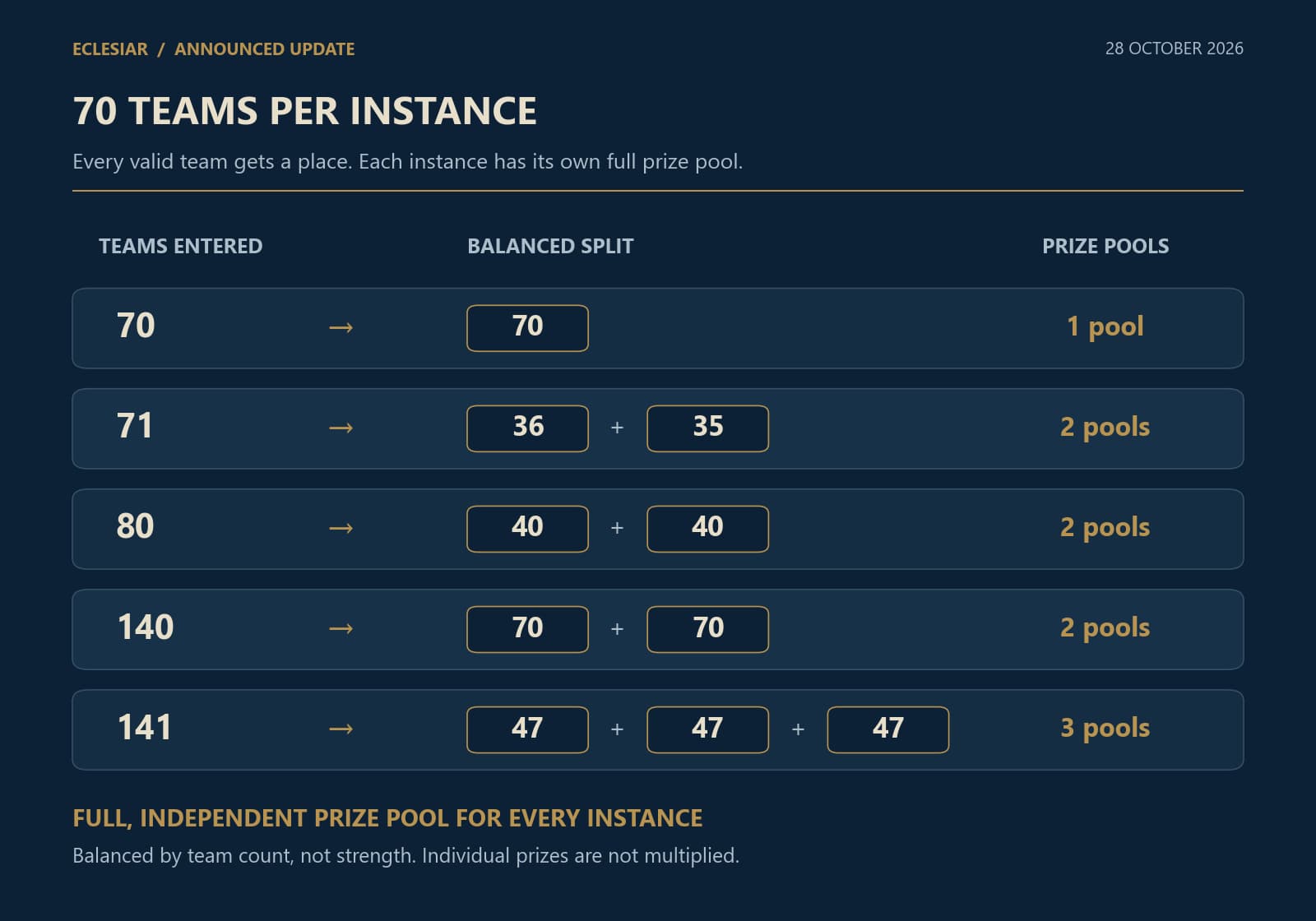
These numbers count teams. With one-player teams, the 80-team example also means 40 players in each instance. Formats that group players into teams can contain more individual players, so team counts and player signups are not always the same. Balanced instances means balancing the number of teams, not promising equal combat strength.
Each Instance Gets Its Own Full Prizes
Every instance will receive a complete copy of the tournament's prize pool. We will not divide one shared pool between the instances.
At 71 teams, there will be two independent competitions and two full prize pools. At 141 teams, there will be three competitions and three full prize pools. Each additional instance will add another full set of rewards, with its own winners and placings.
The rewards for a particular placing will not become larger simply because an instance is added. Instead, more separate competitions will award the same full prize table. Everyone with a valid registration will get a place, and a growing community will create more opportunities to compete for prizes.
Thank you for pushing Eclesiar forward with your questions, reports and participation. We will keep explaining the numbers behind balance changes and improving the systems that bring our community together.