

 العربية
 Deutsch
 Română
 Čeština
 Magyar
 Svenska
 Polski
 Hrvatski
 עברית
עברית Ελληνικά
 Português
 Português (Brasil)
 Slovenščina
 Српски
 Македонски
 Български
 Français
 Español
 Español (Colombia)
 Español (Argentina)
 Español (México)
 Català
 Türkçe
 Nederlands
 Italiano
 Bahasa Indonesia
 日本語
日本語 简体中文
简体中文 繁體中文
繁體中文 हिन्दी
 العربية (مصر)
 Shqip
Shqip ไทย
ไทย Русский
 فارسی
فارسی Українська
 Filipino
 اردو
اردو
Four systems change on Friday, 4 September 2026. Wars stop being a race to erase a country and become a negotiation fought with troops. Alliances start to mean something on the battlefield. Every nation gets its history written down. And the nuclear arsenal is repriced, rebuilt and, for the first time, made stoppable.
Release · Friday 04/09/2026
War 2.0 — declared objectives, provisional occupation, a clock, surrender terms
Alliances — a damage penalty for fighting under a flag that is not yours or your ally's
The Library — every nation's history, written and translated
Nuclear rebalance — new cost, new blast radius, and the Secret Agent who can stop it
All nuclear production costs paid to date will be refunded to national treasuries and storages.
I. The War System
Until now a war ended one way: reduce the other country to nothing. Against a large nation that was never going to happen, so wars ran forever and regions changed hands the instant a battle closed. Both of those are over.
A war is now a declaration with a goal and a deadline
Declaring war is still a congress bill, but the bill must now say what you want and how long you are giving yourself:
Duration — 7, 14, 21 or 30 days.
Goals — one or two named regions of the target that you intend to keep.
The proposal fee scales with the clock you buy: the base war price is multiplied by days ÷ 7, so a 30-day campaign costs roughly four times a 7-day one, before wartime and ideology modifiers. There is no such thing as a war without aims any more.
A country that has been reduced to zero regions can still declare — but every goal it names must be one of its own rightful regions currently held by the target. That is the one exception, and it exists so a wiped nation always has a road home.
You can only start an invasion against a country you hold an active declaration against. The old shortcut — “this region is rightfully mine, so I can attack it whenever I like” — is removed. Cores are recovered by naming them as a war goal.
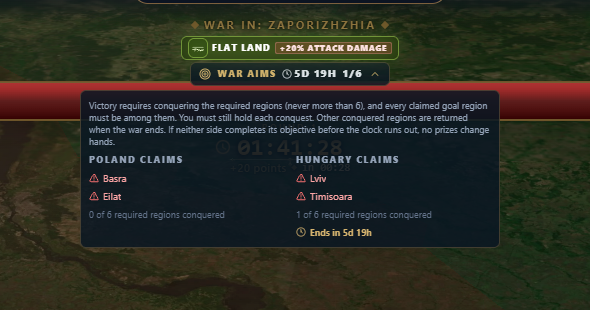
(war in Zaporizhzhia: claims, clock, 1/6 progress)
Winning: the capped objective
Victory no longer means wiping a country out. When the declaration is enacted, the game freezes your requirement:
Required conquests = the smaller of 6, or the number of contestable regions the opponent ruled the day war was declared.
That number never moves again, whatever either country gains or loses elsewhere. To win you must:
conquer at least that many of the opponent's regions, and still rule them; and
have every region you named as a goal among those conquests.
Six captures that do not include your declared goals settle nothing. The goals are the point; the count is only the price of admission.
There is one extra way to complete: if the opponent no longer owns anything you are not already holding — because a third country permanently took the rest — and you have conquered at least one region yourself, the objective completes. You cannot be asked to take ground that no longer belongs to your enemy.
Occupation is provisional
This is the biggest change to how the map feels. Winning a battle no longer hands you a region outright. It hands you an occupation, and the occupation is only settled when the war is.
The region shows as occupied territory, with its rightful owner and the country it was taken from both named.
Its work tax splits while the war runs: the occupier collects 80%, the country it was taken from keeps 20%.
No buildings are damaged by occupation. Holding ground no longer wrecks it.
On the world map, a provisionally occupied region is drawn with a diagonal hatch and a dashed outline in the rightful owner's colour, so a disputed front is visible at a glance.
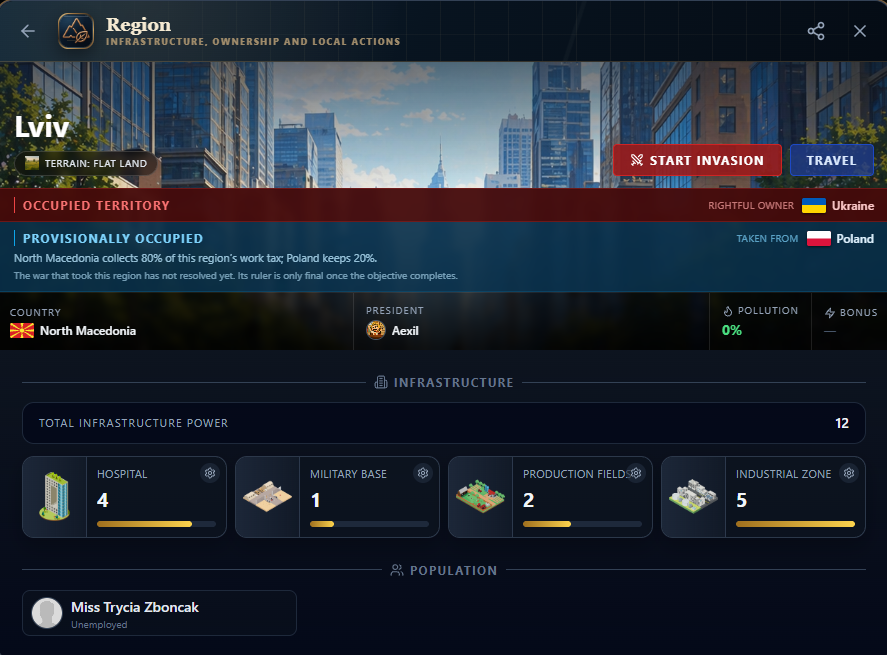
(Lviv: occupied territory, rightful owner, 80/20 tax split)
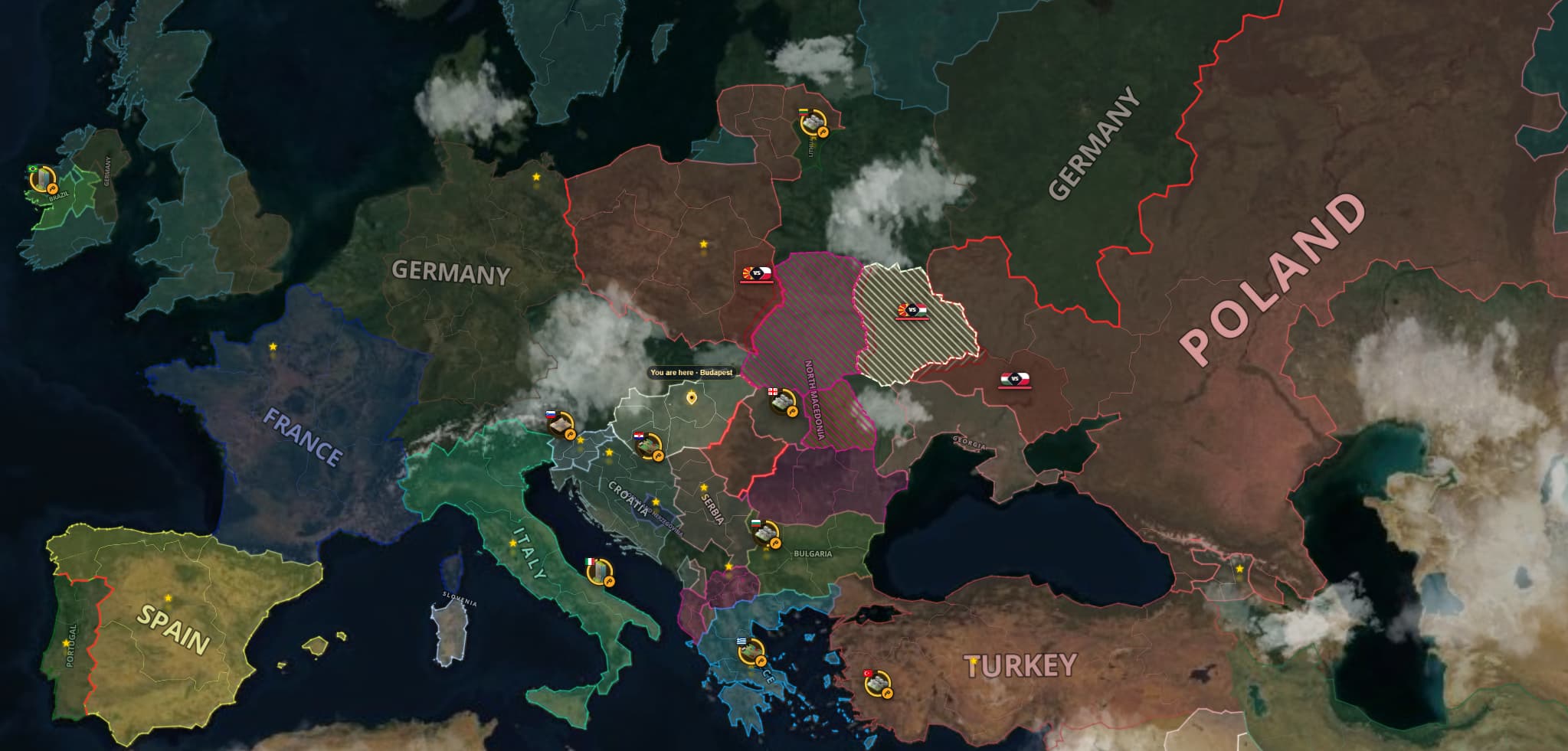
(hatched provisional occupations across the front)
Occupation is not a shield
A war is fought against a country's territory, not against whoever happens to be standing on it. If a third country is occupying ground that belongs to a nation you are at war with, that ground stays contestable — and the occupier defends it, because its troops are the ones on the field. You do not need to declare war on the occupier to fight there.
The consequence is deliberate: holding another country's land now carries risk from everyone that country is at war with. Occupation has a price. A non-aggression pact still protects, though — if you have a pact with the occupier, you cannot attack them anywhere.
The clock, the defender, and surrender
If the deadline passes and nobody completed their objective, nothing changes hands. Every occupation is released, the war closes, and the map returns to where it started. A war you cannot finish is a war you lose by default.
The defender gets an answer. Surviving is no longer the only prize available. A defending congress can vote an offensive objective — a flat 50 gold — naming up to two of the attacker's regions to claim. The window runs to the attacker's own deadline. Without one, a defender that reaches the threshold simply ends the war and takes nothing.
Surrender is now a bill. A congress that has lost can end a war on terms instead of waiting out the clock:
Total surrender — concede every goal region the winner currently occupies.
Partial surrender — concede one of them.
Everything else the winner holds returns to you, the war ends, and a non-aggression pact is signed.
What settlement actually does
When a war resolves in someone's favour, in a single step:
The winner keeps only its declared goals — and only those it conquered and still rules. Every other occupation is released, including regions the winner is the rightful owner of but did not name.
Each region kept loses one level from every building it has. This is the only moment buildings are damaged by a declared war.
Running battles between the two countries stop, the war relation closes, and a 7-day non-aggression pact is signed automatically.
II. Alliances Now Decide Damage
Alliances have been diplomatic paperwork. From Friday they are a combat statistic.
Foreign Fighter: −30% damage. If you are neither a citizen of the side you are fighting for, nor a citizen of one of its formal allies, your damage is reduced by 30%.
The details matter:
The penalty is applied after all of your bonuses — buffs, squad, studies, equipment. You cannot stack your way out of it. The more powerful the mercenary, the more the penalty costs them.
It does not apply in training wars, tournament wars, or against event and boss armies. Those have no nationality dimension and are meant for everyone.
Fighting to liberate a wiped or disabled nation is exempt. A dead country has no government left to sign an alliance with, and it must never become permanently unreclaimable.
Players with no citizenship are penalised. Renouncing your nationality is not a way around it.
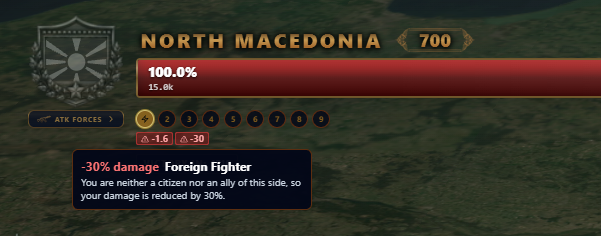
(−30% damage tooltip on the war scoreboard)
Two related changes ship alongside it. You can no longer propose an alliance with a country you are at war with — end the war first. And wartime pricing is now shared across alliance, citizenship and extradition fees alike: each active war involving either country multiplies the fee, at ×3 per war. Diplomacy conducted under fire is expensive.
III. The Library
Everything that has happened in this world has been recorded in a database and read by nobody. The Library turns it into something you can actually read.
Every nation with a past keeps a shelf, and every shelf holds volumes — one per era of that nation's history. A volume opens with the first thing that happens to a country and stays open while its history keeps moving. After five days of national silence the era is considered closed, and a chronicler writes it up.
Each volume has two halves, side by side:
a timeline — every war declared, region conquered, alliance signed, election held, revolution broken out, in order, with every country, region and player named and linked; and
a chronicle — the same events written as prose, in chapters, as national history rather than a log.
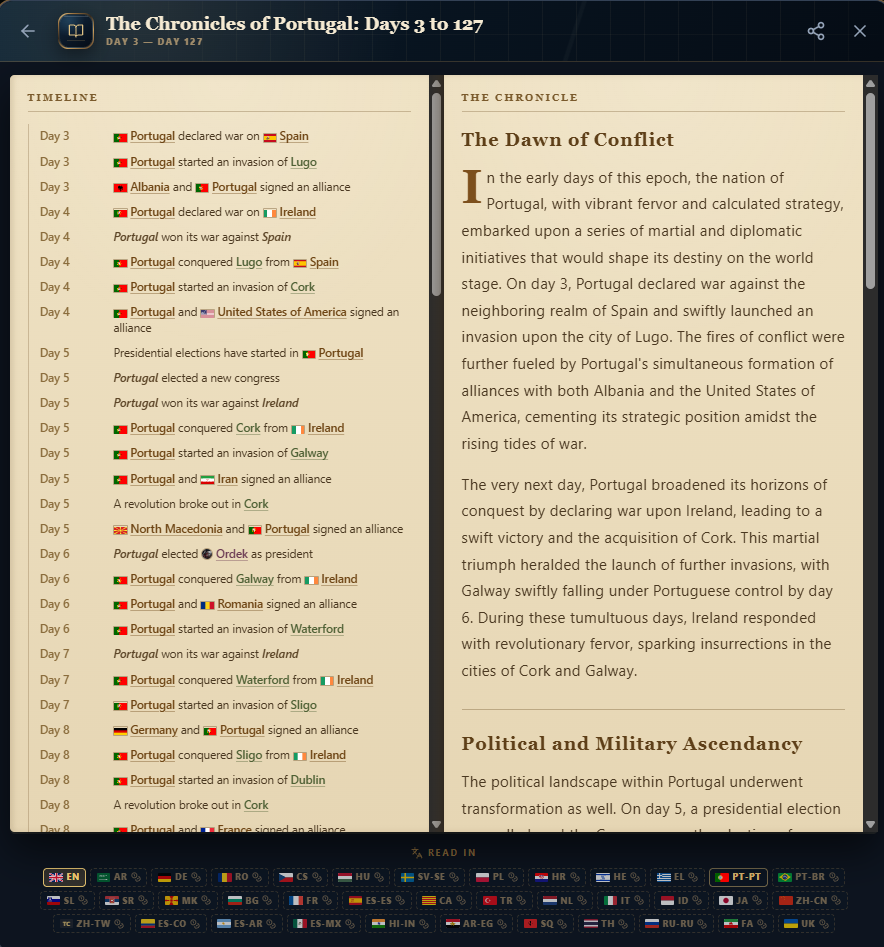
(timeline, chronicle and the language shelf)
Translations are a national expense
A volume is written once, in English. Any nation's president, vice-president or public relations officer can commission a translation of any volume — not only their own country's — for 200 gold from that nation's treasury.
The result is not private. Once a translation exists it is part of the Library permanently, readable by everyone, in that language, forever. Paying for a translation of your rival's history is a perfectly reasonable act of statecraft. If a translation fails to complete, the gold is returned automatically.
IV. The Nuclear Rebalance
The bomb was too cheap and too weak. It cost less than a decent weapon and knocked one level off two random buildings. Both halves are fixed at once: it now costs what a strategic weapon should cost, and it does what a strategic weapon should do.
The new price
Nuclear production cost, before country ideology modifiers
Resource | Old | New |
|---|---|---|
Gold | 30 | 750 |
Oil | 500 | 12,500 |
Iron | 100 | 2,500 |
Titanium | 200 | 5,000 |
Production still requires a level 5 Military Base and government authorization, takes 48 hours, and a region can only run one nuclear build at a time. A completed bomb takes 3 hours to reach its target after launch — three hours in which it is visible to the entire world, and three hours in which it can be stopped.
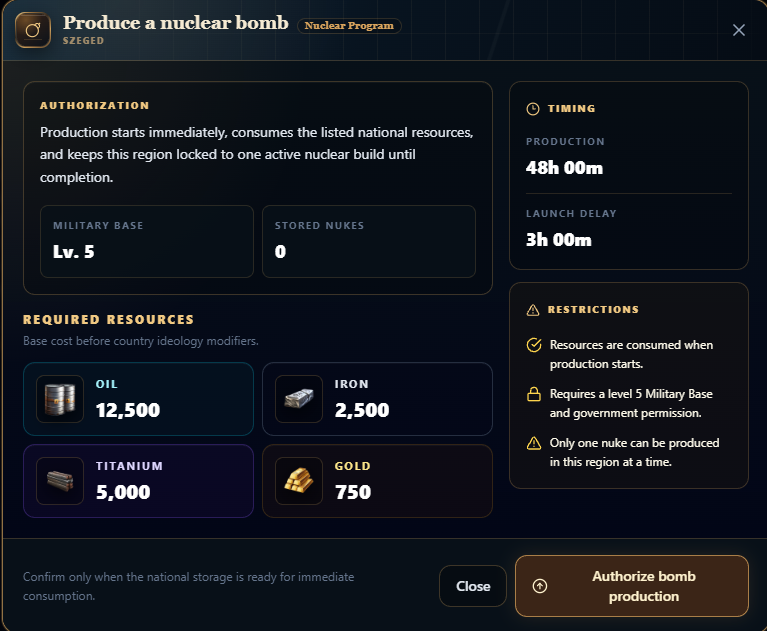
(authorization, resource cost, timings)
The new blast
A nuclear strike no longer nicks a couple of buildings. It removes a region from the war.
The target region is levelled. Every building drops to level 0 — hospital, military base, production fields, industrial zone, and any event or special structure it holds.
Every nuke stored in the target region is destroyed. A first strike on an arsenal is now a real strategy.
Every connected region loses one level from one random standing building. If that building is its Military Base, the nukes stored there are destroyed too.
The strike report has been rebuilt to match: damage is now broken down region by region, with the primary target and each connected region labelled separately, so you can read the full extent of a hit at a glance.
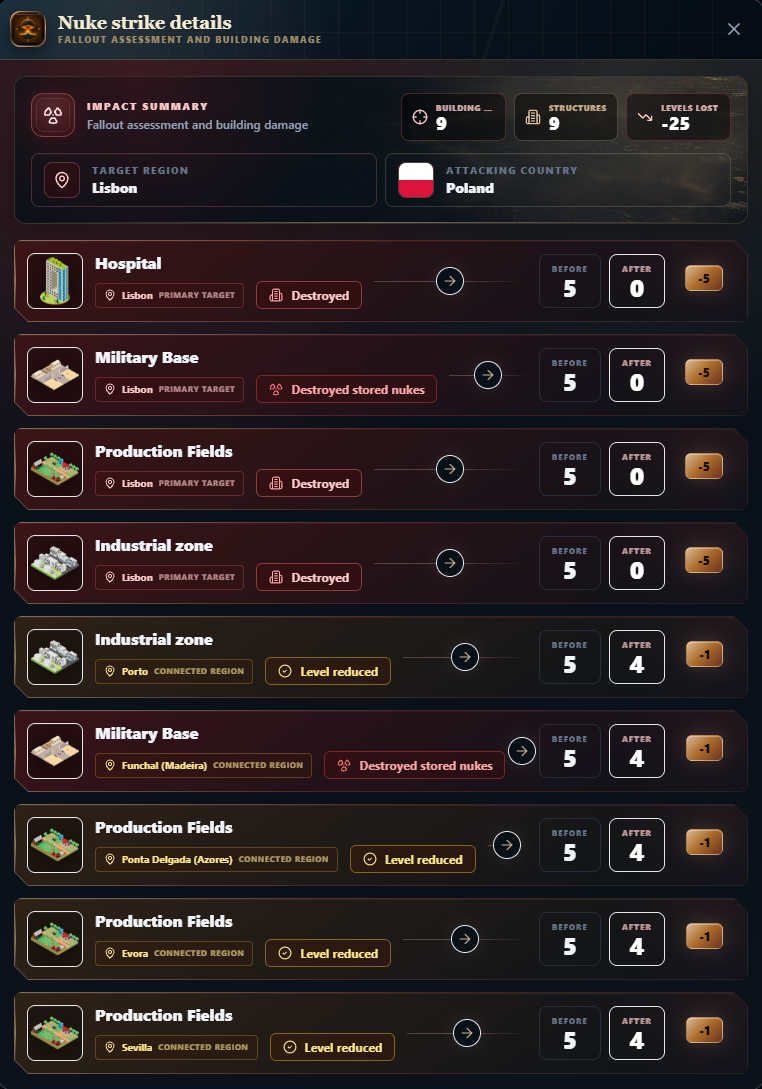
(Lisbon levelled, five connected regions damaged, −25 levels)
Every nuclear cost paid so far is being refunded
Treasury notice
Nobody should be punished for having built at the old price. At release, every nuclear weapon will be refunded to the country that paid it — gold back to the national treasury, oil, iron and titanium back into national storage. It is a one-time settlement, applied automatically.
Counter-nuclear: the Secret Agent
A weapon this powerful needs an answer that is not another weapon. The Secret Agent study is that answer, and it turns those three hours of flight time into a window someone can act in.
The study is learned at a level 4 Military Base in a region ruled by your own nation. Governments can leave it open or restrict it to an invite-only list of their own citizens. It unlocks two operations.
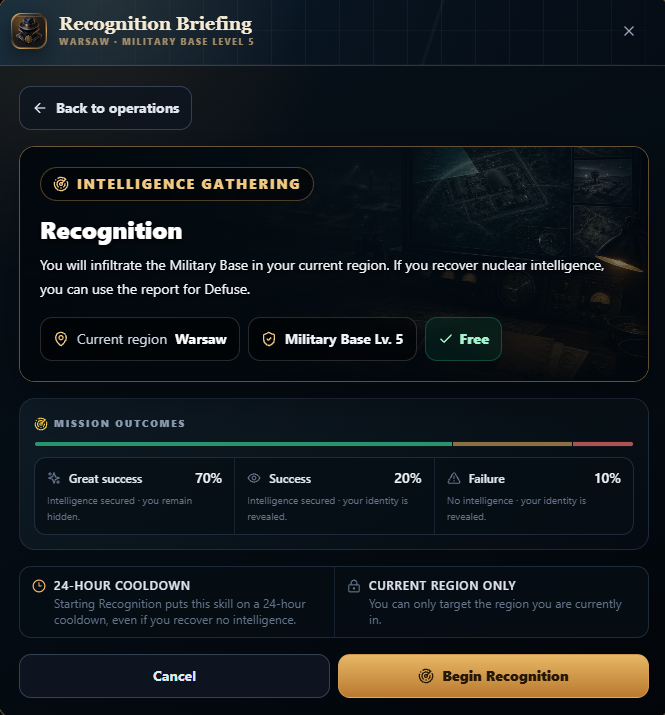
Recognition — find out what is there
Infiltrate the Military Base in the region you are standing in. Requires a level 5 Military Base, costs nothing, and puts itself on a 24-hour cooldown on every attempt, successful or not.
Outcome | Chance | Result |
|---|---|---|
Great success | 70% | Intelligence secured — you remain hidden |
Success | 20% | Intelligence secured — your identity is revealed |
Failure | 10% | No intelligence — your identity is revealed |
Defuse — destroy the stockpile
A successful Recognition report names a region and the nuclear stock it holds. Defuse spends that report. You must still be in the region, and you choose how many of the observed warheads to attempt.
Each attempted nuke costs 50 gold and 1,000 ticket pollution points, paid from your own ticket qualities, and each one is rolled independently:
Outcome | Chance per nuke | Result |
|---|---|---|
Great success | 25% | Nuke destroyed — you remain hidden |
Success | 25% | Nuke destroyed — your identity is revealed |
Failure | 50% | Nuke survives — your identity is revealed |
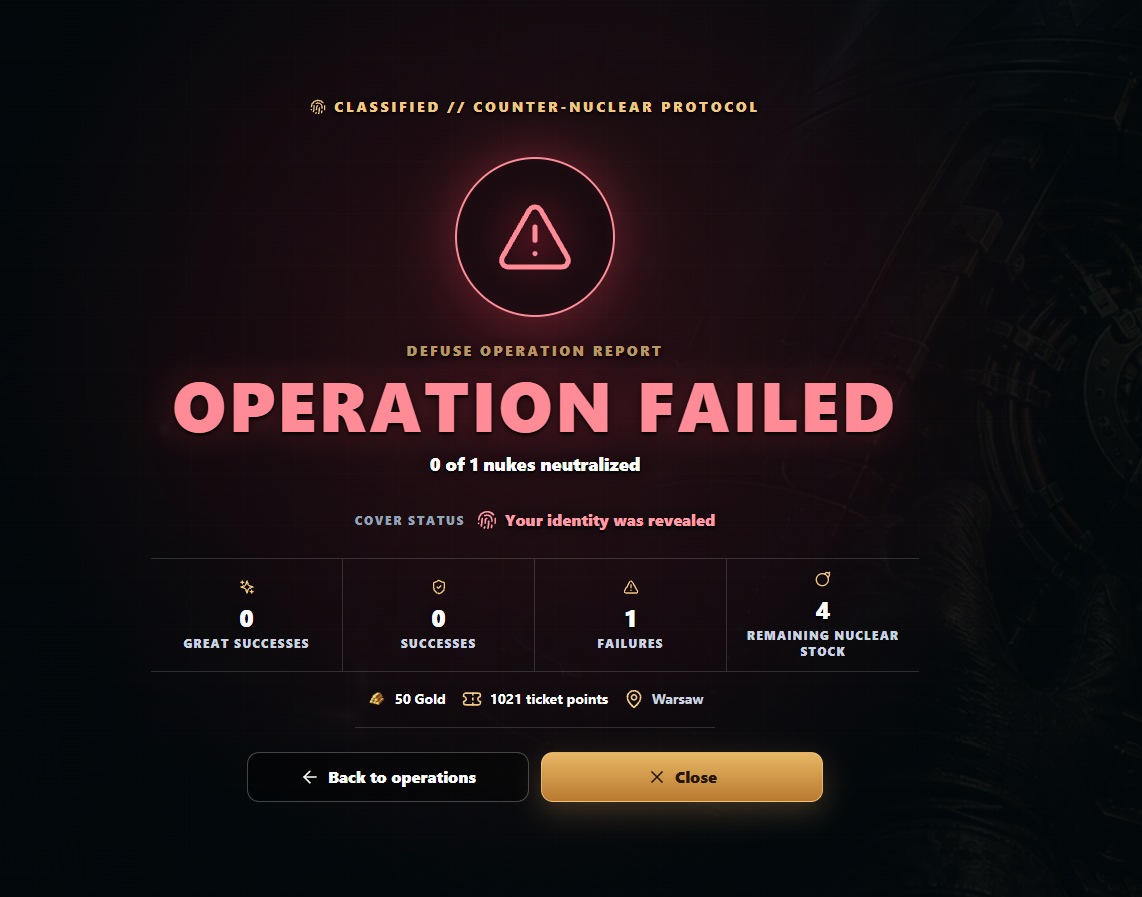
Any ordinary success or failure exposes you once for the entire operation, not once per warhead — so a large batch is not a larger risk of exposure, only a larger bill. If the region's live nuclear stock no longer covers what you asked for, the operation returns stale intelligence before charging you anything.
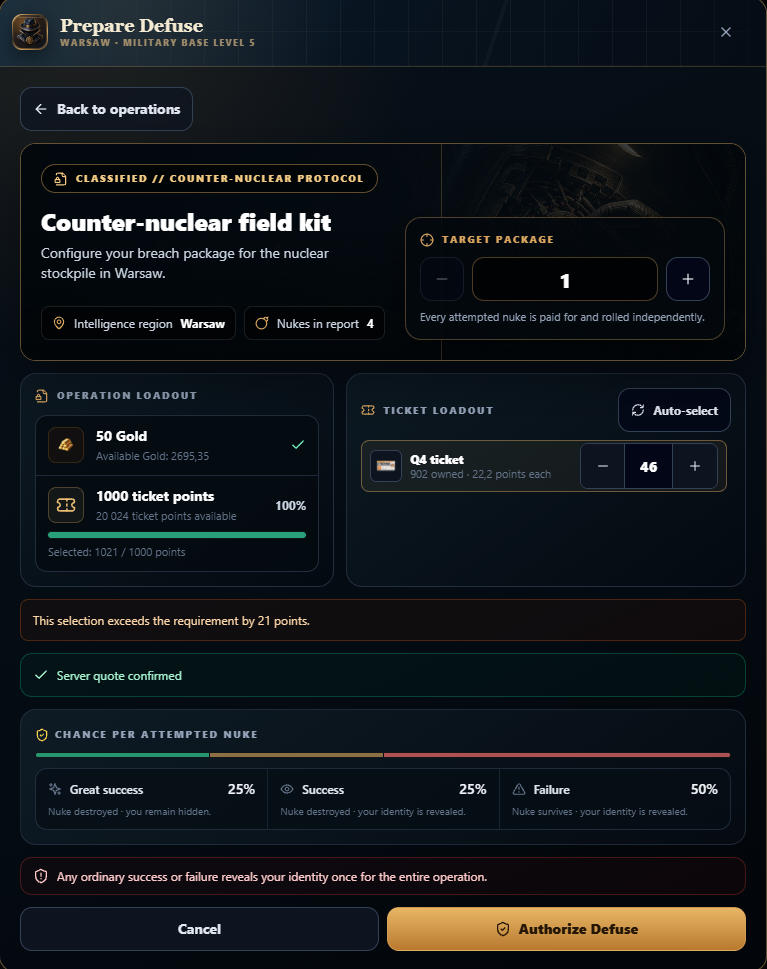
(target package, loadout, odds)
Get caught, and the world finds out. Exposure publishes a Nuclear Sabotage event naming the agent, their nationality and the region — which is, of course, an excellent reason for somebody to declare war.

What This Means
Taken together, these four changes push the world in one direction: towards consequences you can see coming.
A war now announces what it wants and when it must be over, so the countries around it can decide whether to care. Ground held by force is visibly held by force, pays its tax to two masters, and can be taken back by anyone with a claim. Fighting under a foreign flag costs you a third of your damage, so alliances are worth signing before the shooting starts rather than after. And a bomb costs a fortune, flattens a region, and can be found and defused by a single player standing in the right place at the right time.
None of it is quiet. All of it is now written down — and in five days of peace, somebody will write your era's chapter.
Live Friday, 4 September 2026. Feedback, as always, in Discord and in the in-game support channel.