

 العربية
 Deutsch
 Română
 Čeština
 Magyar
 Svenska
 Polski
 Hrvatski
 עברית
 Ελληνικά
 Português
 Português (Brasil)
 Slovenščina
 Српски
 Македонски
 Български
 Français
 Español
 Español (Colombia)
 Español (Argentina)
 Español (México)
 Català
 Türkçe
 Nederlands
 Italiano
 Bahasa Indonesia
 日本語
 简体中文
 繁體中文
 हिन्दी
 العربية (مصر)
 Shqip
 ไทย
 Русский
 فارسی
 Українська
 Filipino
 اردو

Greetings, dear.
A newcomer's production guide that I've studied, here.
For a better understanding of this article, I recommend reading it too.
It is short, with pictures, easy to read. This will give you a better understanding of what is written below if you are a beginner.
However, in that guide, I personally lacked some information that I plan to outline in my far from short guide. I managed to create a truly profitable company with only 3 attempts. And all because when choosing a place of production, it is important to pay attention not only to bonuses and pollution, but also to the availability of available labor in the region, which is not a word in the beginner’s guide. It can happen (and beginners often do) that factory In general, efficiently - produces products, but the high cost of these products does not allow you to earn well, and sometimes even at all. You have to work in the red just to sell products from the warehouse..
At the time of writing, it is quite possible to build profitable raw materials enterprises of level 2, and after upgrading to level 3 - to establish a profitable production chain in conjunction with a factory of level 1, 2 or 3. I won’t tell you what and where, but I will try to give a method so that you can find such places yourself.
Key and important points from the guide to the beginner
Decide on the goal: raw materials or products.
Choose the right region.
Consider the impact of the number of employees on the outcome.
Pump up the production.
Don’t move low-level companies to another region.
However, there are a number of nuances that are missed in the beginner’s guide.
Let's go in order, but I'll start with the main thing, the goal.
Purpose of construction
What are you building a company for?
Do you really want to make the most money on the production and subsequent sale of goods?
Or do you need a company for self-reliance, like making weapons for combat?
Or do you want to make the country stronger?
Depending on the answer, the path will be different.
If you want to help the country
A significant part of the Eclesiar economy is built around NPC.
The number of NPCs depends on the value of active players for each region.
For an NPC to emerge, players need to invest an additional 440 gold in building or improving companies.
For this reason, every country is interested in companies being established and developed on its territory. And Russia is no exception.
However, in the absence of bonuses and high pollution, production in Russia becomes profitable only at high levels. One of the options for combining the benefits of Russia and own income is to produce resources abroad (or buy them on the market where it is cheaper), and in Russia concentrate on the production of final products.
Raw materials
The production of raw materials becomes profitable from level 2, but this is possible only in countries with a large territory and a small number of active players.
If you are building in Russia, it is better to start with the production of finished products.Buy raw materials, including abroad.
If you are building abroad, how is it better to start with the production of raw materials, which will ensure a low cost of further production? Sometimes it is possible to find a region with a cost of 0.005 gold per unit of goods even for the production of level 2.
TOTAL:
If you want to help the country - build a factory of finished products in Russia
If you want to make more money, stop producing raw materials abroad.
The most important thing is the right region.
The right region for factories is any region of Russia, without occupation.
Now it's just Moscow. However, Moscow will not give us the profit that others can give.
We will clarify the question that we will discuss further:
- How to choose the right region for maximum profit?
To do this, you need to find a region with a minimum cost of production.
How do you do that?
1. See with help ECL Tools regions with the highest level of production.
To do this, choose the type of product, the level of production (with some margin for the next expansion) and the level of economic power of the employee (for NPC set 0, for player 40).
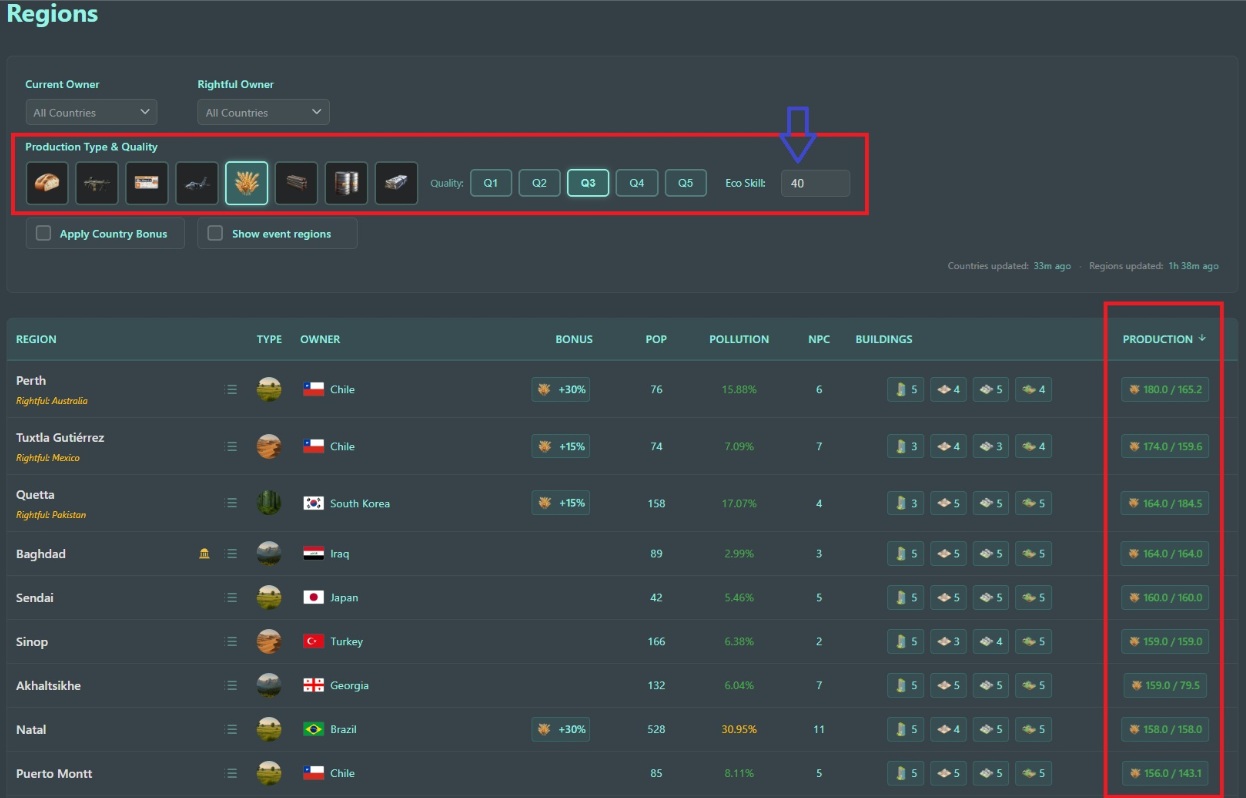
Next, sort the column by decreasing the number of products.
The first number in the column is the product that the employee-player produces, and through the fraction - the product that the NPC-employee gives. Depending on the ideology of the country, NPC output can be higher (as in the screen above in Korea, where capitalism is developed), or much lower (as in Georgia, where socialism prevails). But the ideology can change. Therefore, you should not count on NPC performance for high-level enterprises - for Q4-Q5 productions, bet on working with real players.
By the way, a worker with a skill 40 produces 80% more output than a worker with a skill. The dependence here is linear - every 1 point of economic power gives plus 2% to production.
It would be very easy if that was everything. But it's not.
So far, we have only learned how much our company will produce with 1 employee. The first employee has 130% productivity (and ECL Tools already takes this into account), the second employee 120%, and so on – each subsequent employee removes 10%.
When choosing a region - take into account the salary of employees
It's harder. Real players are willing to work with a salary of 2 gold after taxes.
In Chile, the current labor tax is 15%, which means that a real player will have to pay 2.4 gold. In this case, the player will try on the exchange rate of the local currency not at the price at which the currency can be bought, but at which it can be sold. So you need to go and see what is going on with the purchase price of currency.
You can run your eyes through the glass:
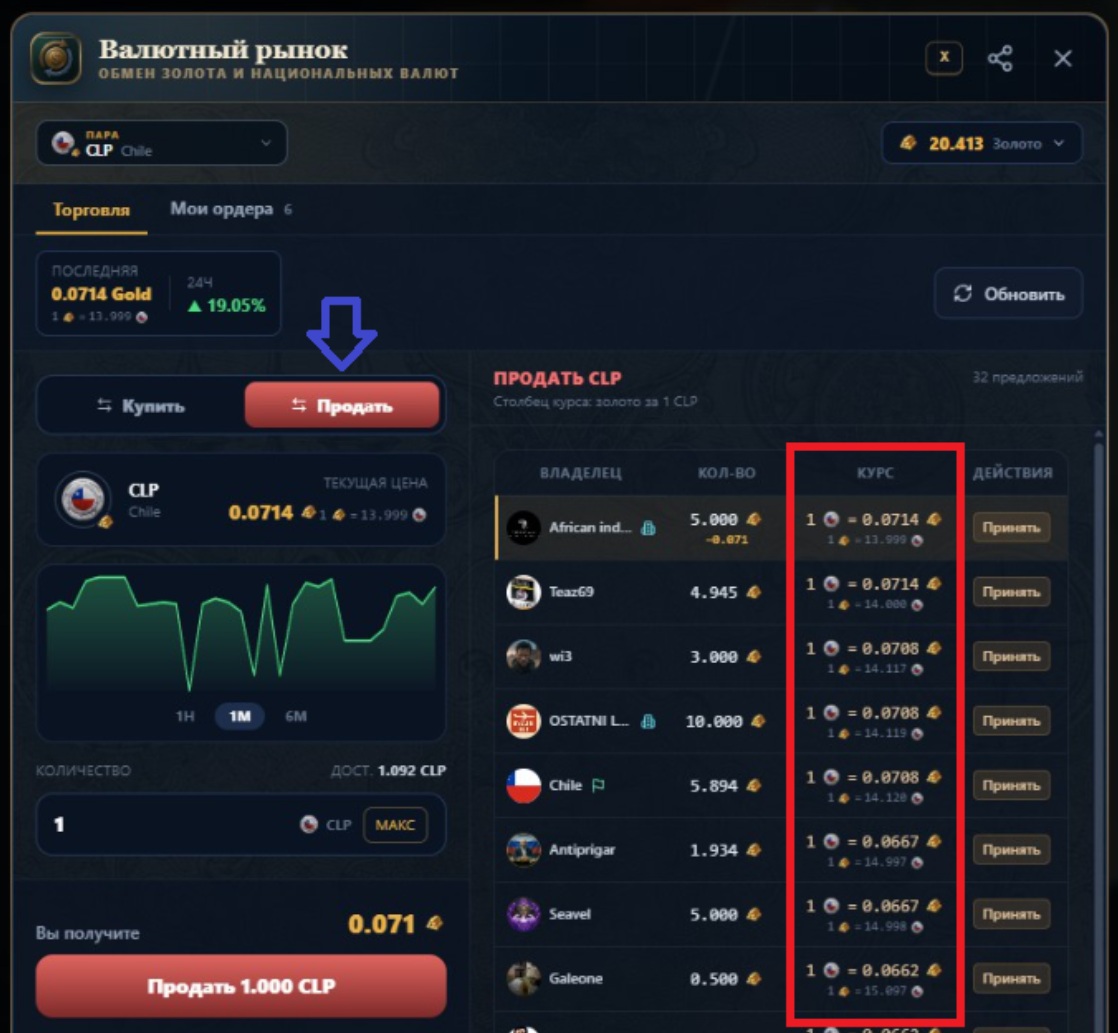
And roughly figure out the course.
Or go to the My Orders tab and enter the tax-adjusted PP in gold in the Gold to Pay window:
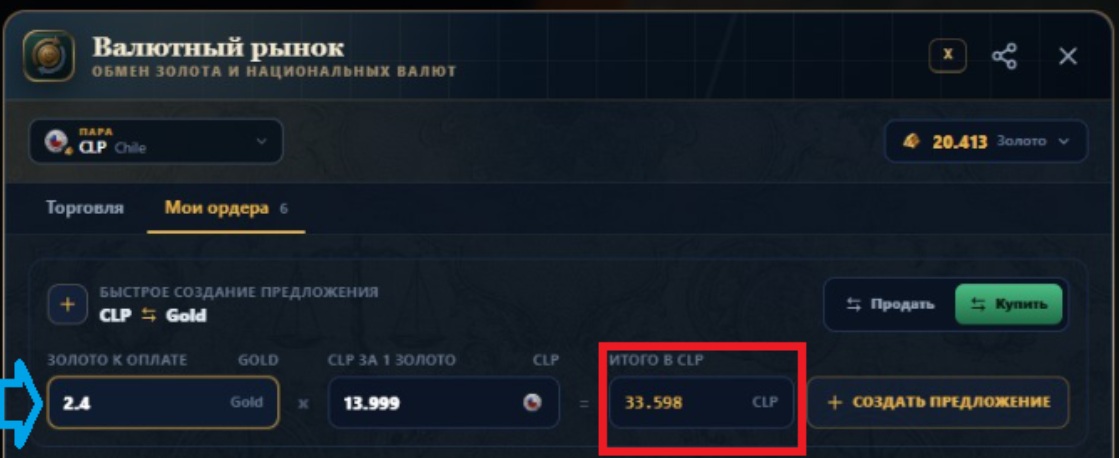
The exact formula for a 2-gold ZP: 2/1 is the labor tax rate, for Chile it is 2.4
In the end, we will get a figure close to a fair salary.
But we didn't come here for a fair salary, did we?
So we just go into the job market and look at the wages.
Unfortunately, only NPC character salaries are readily available.
Click on the regions of the country and look at NPC salaries:
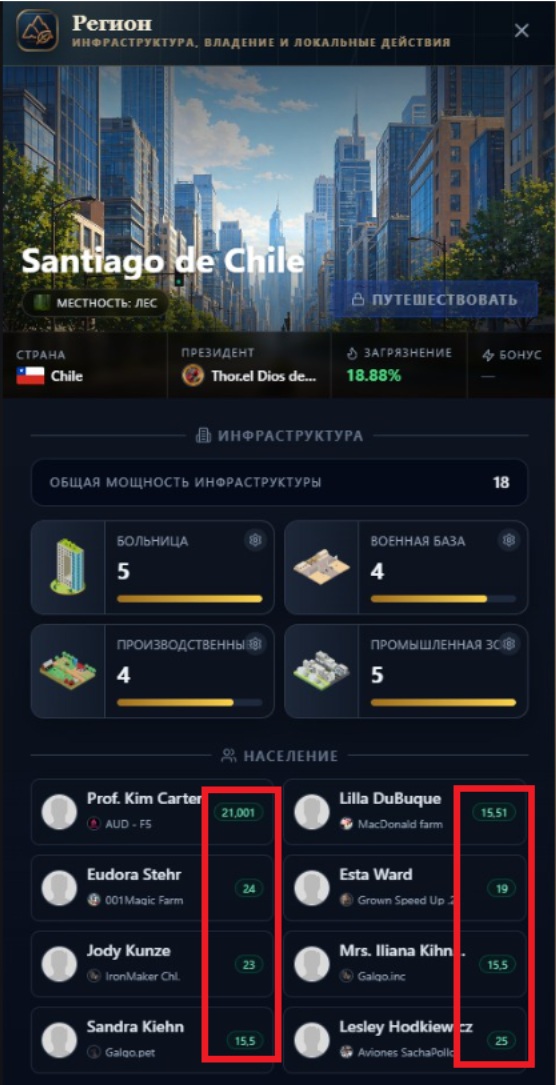
It is important to remember that the NPC is changing jobs to more paid jobs within the country.
It is also important to know that an NPC will not work for a salary below 80% of the average.
Well, I remind you that an employee-player produces an average of 70-80% more products than NPC, so he can have 2 times more RP due to savings on materials.
In fact, in the screen above, we can see that for 15,511 we can lure only 3 NPCs to ourselves in this region. But at this price, they will quickly be lured back. In the end, if you look at other regions like Chile, you'll see that a stable NPC salary is around 21 Chilean pesos.
Sometimes we can graze countries with unemployed NPCs. As a rule, in the ECL Tools rating, such regions are slightly lower in performance and have low pollution values. In such regions, salaries can be even lower.
How can I find out what kind of salary an unemployed NPC has?
There is a rule - the NPC will work for the PP at least 80% of the average.
It's weird, it makes so much, and the PP wants big, but it's like life, isn't it?
Let's take a look at the average ZP in Chile (for this we go to the country information, in the Policy section):
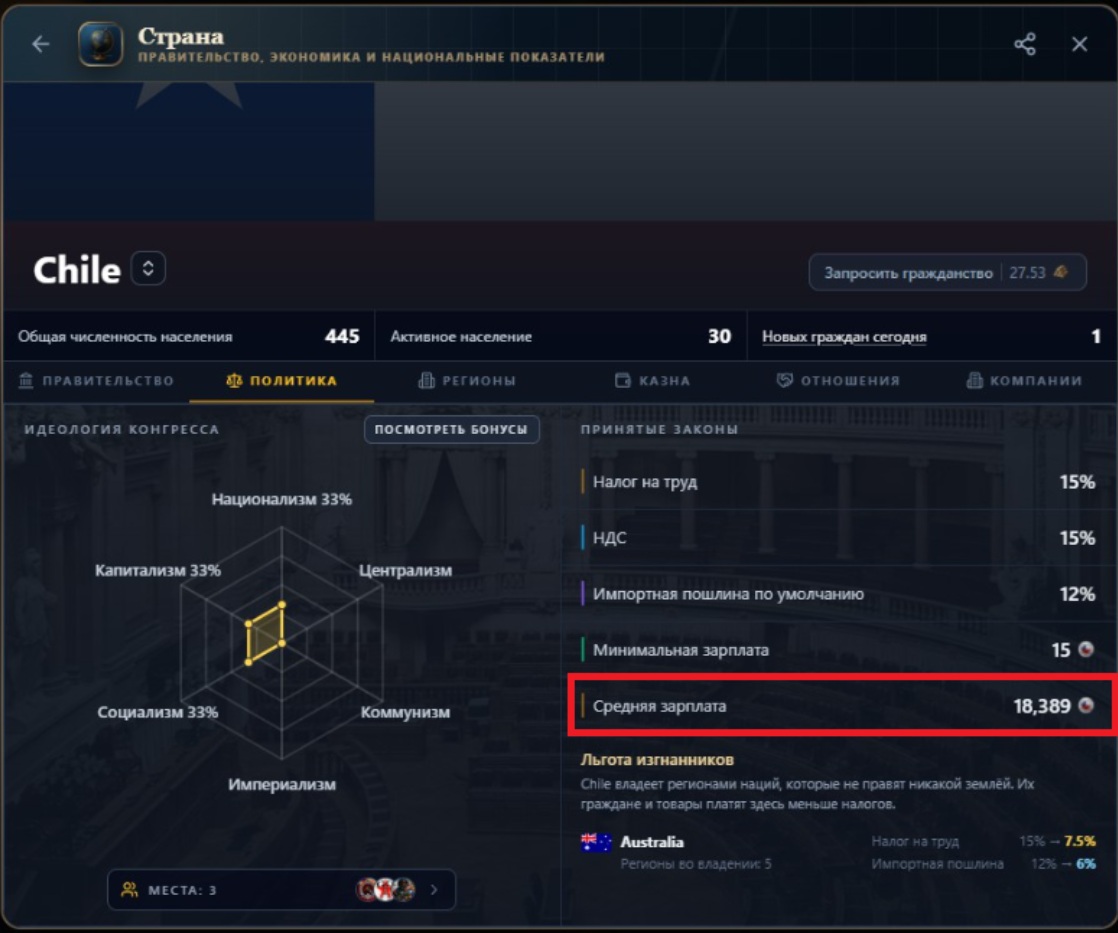
The NPC in Chile will not work for less than 14.72 pesos.
So, We found out the salary in the region.
About 21 pesos for the NPC or 33 for the player.
The player gives us 179 products from Q3 farm and NPC 99.
Calculate the cost per 1 unit of production
In our case, the calculation will be as follows:
NPC: 21/99 = 0.212 pesos
Player: 33/179 = 0.184 pesos, but he still has to be found, he may not work every day
In general, it is better to focus on NPC for stable work.
By the way, if you bother, you can try to shun NPC for 15.511.
In this case, the cost of production will be 15,511/99 = 0,157, already more interesting than a real player with a ZP of 2 gold.
Okay, that's not all.
Next, you need to understand the cost of gold.
Let’s see at what price we can buy the currency.
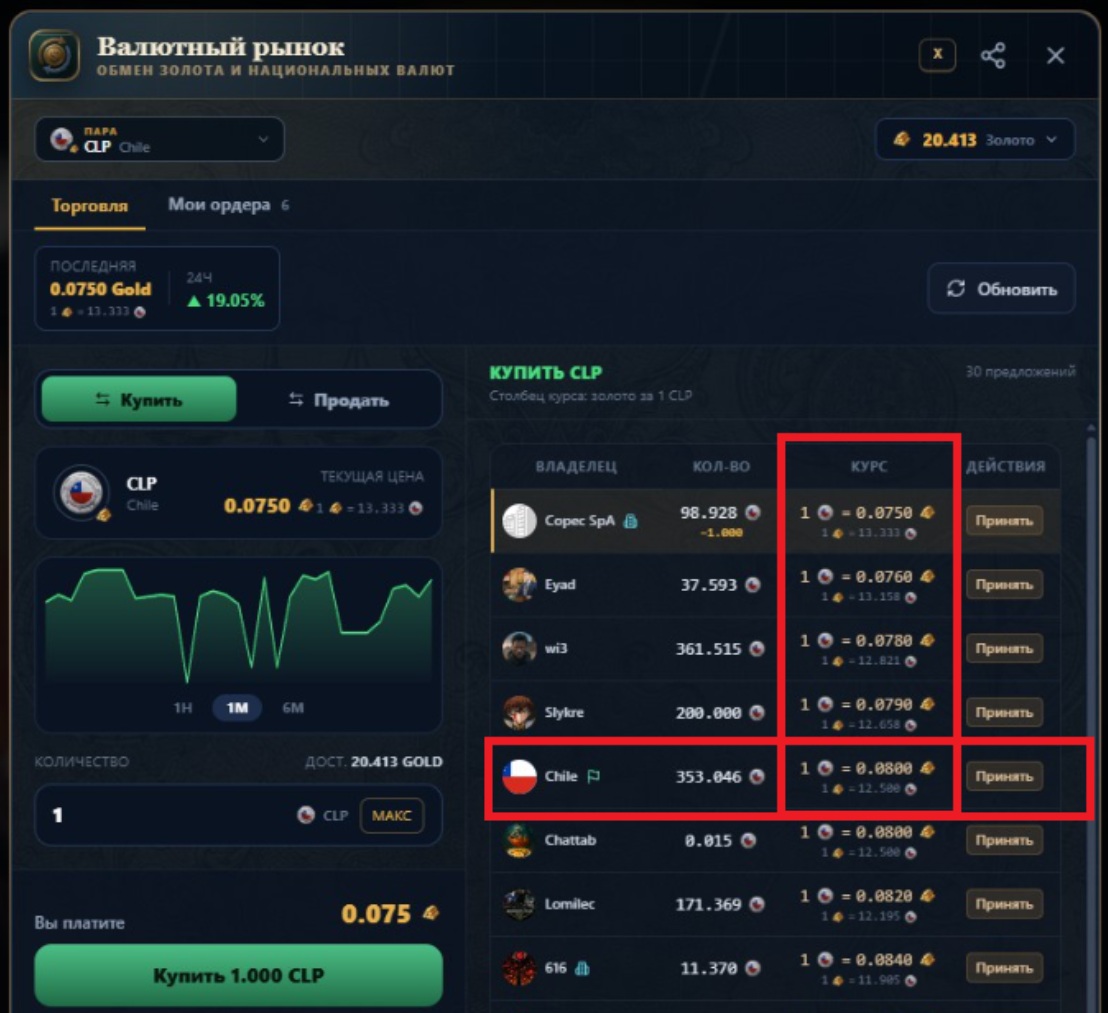
Usually this is the rate of the seller of the country, other transactions are more risky.
So we have a rate of 0.08 gold per Chilean peso.
We consider the cost of goods:
0.212*0.08 = 0.01696 gold our stable Q3 farm cost
0.157*0.08 = 0.01256 gold our risk cost when trying to hire a low-wage NPC
For factories, it is also necessary to take into account either the salary of employees in the production of raw materials, or the cost of raw materials on the market.
Is the cost normal or not?
Now let’s look at what price we can buy grain.
For this we use another section. ECL Tools - MarketWe choose the type of products we need and sort by price increase:
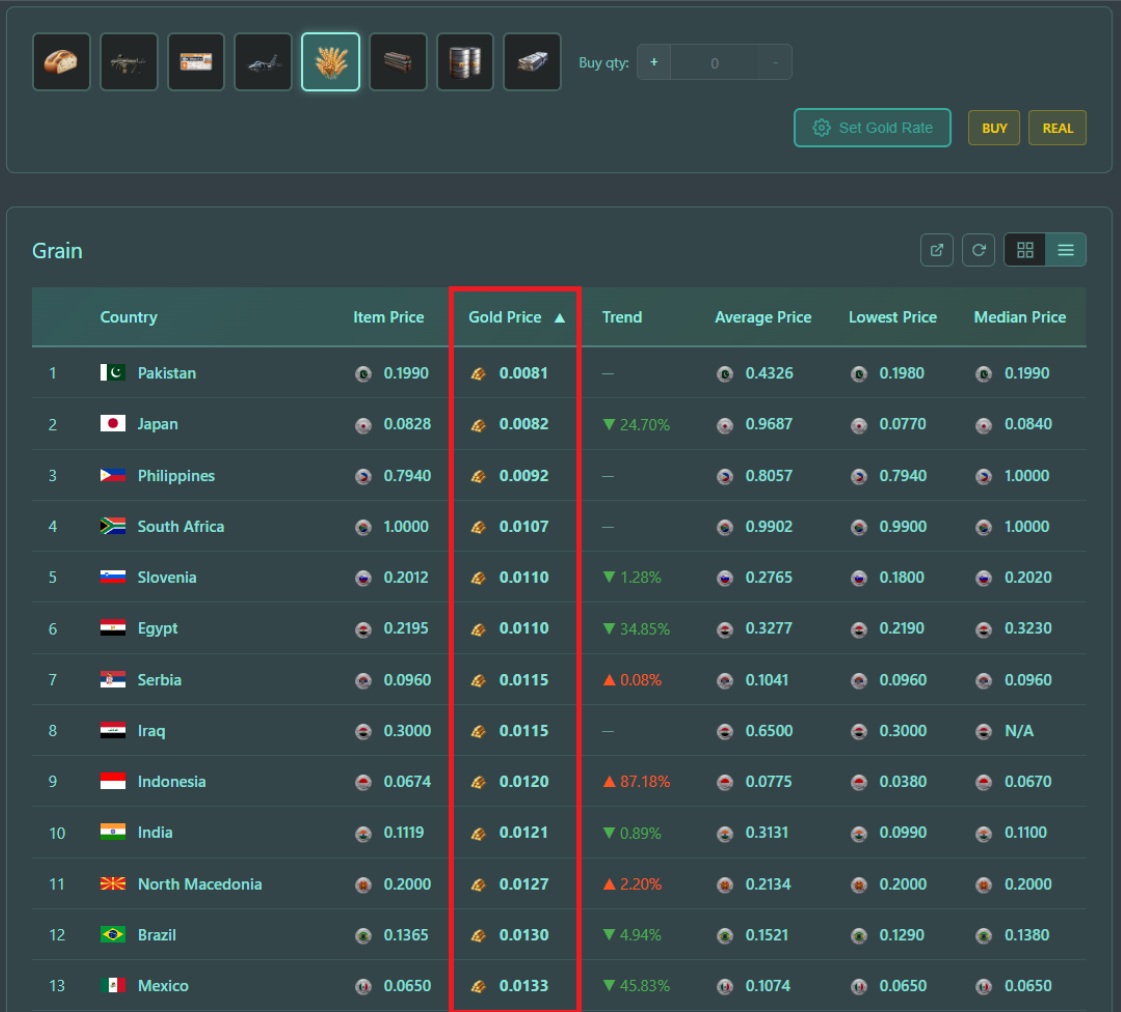
Look at the prices of the first 10 countries. If our price is much lower - great, we found a good place to build. But in our example, the market price is below our cost. This means that there is no point in building a Q3 production facility in this region. It's easier to buy from the market.
Reader, are you still here?
You sure you want to keep going?
Or can it be easier to buy resources from the market, bring them to their home country and produce final products there? This is really easier and more useful for the country, but we are looking for benefits.
What do we do next if we want grain?
Take the next country on the list from ECL ToolsRepeat the analysis.
In general, the algorithm for choosing a region is as follows:
1. Look at the performance in the region ECL Tools.
2. Checking salaries in the country.
3. We estimate the cost of 1 unit of production.
Do not forget to consider the cost of materials for factories
4. Compare it to the market.
5. We got the cost 2 times lower - build!
It's really only the first time long, and then you learn to appreciate on the fly.
In literally 3 iterations, I found a place with a cost of 0.0032 per unit for a Q3 farm.
However, such places are unstable - literally today or tomorrow the territory I found will be taken over by another country with significantly higher wages ... so the geopolitical factor must also be kept in mind.
Summary:
The right region is the one with the lowest cost per unit of production, and the region should be stable and not at risk of capture. Even though it's Eclesiar, what's the stability? ;
The impact of the number of employees on the result
The first employee produces the amount of resources that is reflected in ECL Tools + country bonuses + your leadership skills. That is still a little more than ECL Tools shows if you have bonuses and skills.
The second worker produces 1/13 less.
The third worker produces 2/13 less... and so on.
I suspect 14 workers don’t produce anything, and 15 may even be stealing a bit from the warehouse... but I didn’t check. Take a look at this for yourself.
Start with 1-2 employees, and there you will find your way.
More than 3 makes sense to hire only workers-players who may not work every day.
The penalty for the second and next employee applies only to those who have worked. If an employee is hired but does not work, then there is no penalty and salary costs.
Pump production
Here it is important to say that the country would like to see the production of final products level 5 in its territory. Up to level 5, you can place production anywhere, but the presence of level 5 production outside your home country can be due to only one thing - the inability of the country to ensure its profitable operation.
But don't worry. Develop production where it is more convenient, and as it develops, it can be moved to your homeland. Before moving, first calculate the economy – whether level 5 production will be profitable in your home region.
Algorithm, short.
1. Choose a region with help ECL Tools.Regions.
2. Analyze the salaries.
3. Calculate the cost per 1 unit of production.
4. Comparison with the market by ECL Tools.Market.
5. Build if the cost is significantly lower than the market, otherwise repeat from paragraph 1.
Bonus patient
Do you already have a 4 or 5 level factory abroad and are you ready to move it to Moscow or another region of Russia? Contact me (or the Secretary of Labor, which will come after me) and we will discuss additional benefits for your company to offset the cost of moving.
So, there is no paid content, just thank the author for the work.
Don’t expect anything but gratitude.
